Having moved my business to Portland from Oakland some 11 months back, I was faced with the task of attracting some new clients. Granted, I brought my core clientele with me, but any business needs to continuously market itself, indeed it is essential to recreate a business daily to survive.
Wanting to create a high profile for my custom screen printing shop in my new location, I opted for a display ad contract with the leading local “Alternative Newsweekly”, Willamette Week. I know from experience that this type of advertising is expensive, and it is unrealistic to expect a dollar for dollar return on it, but I was confident that it would successfully present my new business name, logo and selling proposition to the local market.
I was not disappointed on any count; it was expensive. While I attracted several clients from my 36 ad campaign, they have yet to pay for the ads (but they might; one new account attracted by the ad shows great promise). I am satisfied that slamming my logo and sales pitch at the local alt weekly readership for 36 of the last 48 weeks has indeed had the desired effect: Readers of Willamette Week undoubtedly know that Manx Media means quality custom T-shirt printing!
Next, I began sloggin’ away at an ambitious direct mail campaign within a couple months of getting to Portland. This is labor intensive, detail oriented work: Developing mailing lists of prospective customers and creating a series of postcards to mail to the lists, constantly updating and adding new lists while honing my marketing message. Direct mail is a big effort to properly execute, but over the years, these postcard mailings have developed into my number one tool (next to recommendations of course) for attracting new accounts. I should mention it always works best when I develop my own lists, rather than with a list purchased from a broker.
Once I had my display ad and direct mail campaigns under way, something amazing and wonderful happened—I discovered Google Ad Words. Focusing on the Portland metro area, using this online advertising service brings me quote requests from people who have searched for exactly what I am selling. And I only pay for people who actually click through to my web site. The unique tools offered by Google allow me to set my budget where I need it to be.
It is essential that my site very clearly states my selling proposition, and directs the potential client to email me for a quote, but here is the bottom line: It bloodly well works like a charm!
As the world becomes inundated with more and more advertising messages, I have noticed that direct mail returns less of a response over time. Well, I’m here to tell you that for a given budget, Google Ad Words has outperformed direct mail, and display advertising, by a ratio of at least ten to one. No lie.
It is worth noting that Yahoo and Microsoft are both nipping at Google’s heels to provide this type of focused advertising, so keep an eye on those companies offerings.
So here I am, busy as hell with tons of work. I went to Google the other day and turned my campaign off, for the time being. Whoa! Who knew? I suppose I could power up and add capacity to my business and expand and all that horseshit, but honestly, I’d rather smoke a fatty and draw some comics!
Tuesday, May 09, 2006


Thursday, March 23, 2006
Read This Before You Give Up

What defines success as an artist? Money? Groupies? Perhaps fancy cars, vacations, houses, etc.? Nope, not even close, none of the above.
From the start, I’ve always paid myself generously in the commodity that an artist values above all others: Time. Plain and simple, success as an artist is defined as ample time to make art.
Yes, we are assuming that you have a roof over your head, and food to eat. Whatever scrambling you have to do to make that happen, do it as efficiently as possible with no waste—no wasted time that is!
What does an artist do? Make art. An artist, I believe, should be less concerned with their end product, and more concerned with process. Engage in the process, and you improve technically, you get real darn good at your craft. Engage in the process, and your muse finds a way to sneak boatloads of good ideas in the back door in the dead of the night. And what does a body need in plentiful supply to engage in the process of making art? Time!
The art life is not about ending up with pretty pictures. Or sculptures, films, songs, drawings, comics, novels, whatever. It’s about the process of creating all that stuff; the journey itself, the illumination, the epiphanies encountered along the way are the true rewards.
Monday, March 20, 2006
Clean Energy/Clean Tech and the Future
Recently I have become obsessed with the Clean Energy and Clean Tech fields for the simple reason that I have kids; being a parent tends to make a guy want the earth to thrive and the human race to survive.
A Scottish scientist (what the hell was that dudes name?!) was in the news a couple months back, predicting that within 100 years, the only remaining habitable areas of space ship earth will be the artic region. With rising temperatures, melting polar ice, desertification of much of the planet, and rising sea levels, this guy thinks we will have billions of people dying off, with just a few breeding couples left, as we’ve made the earth sick with all the fossil fuels etc.
I’m sure there are varying opinions on how bad Global Warming is now, and how fast it will get worse, but only greedy jerks like Bush/Cheney and friends can still pretend it ain’t for real.
I hope the aforementioned Scottish scientist is just a wee bit off on his scheduling of the extinction of 99% of humanity!
In any case, there have always been lots of great arguments for Clean Energy and Clean Tech, in terms of what is good for all the creatures on the planet, not to mention Mother Earth herself! Up until recently, “it’s good for business” hasn’t been one of the arguments for Clean Energy and Clean Tech, quite the opposite.
Guess what? That has changed, big time! It appears that investors, venture capitalists and other money oriented types see big opportunities in all this Green & Clean stuff!
Here is a link to an article that posits, among other things, that Clean Tech/Clean Energy investment may offer 5-10 year compound annual revenue growth rates as high as 35%:
http://www.renewableenergyaccess.com/rea/news/story?id=42742
I’ve blogged plenty about self-employment, and naturally I stand by every word. But if self-employment ain’t your thang, especially if you are young, I strongly urge you to consider Clean Energy and Clean Tech as great fields to pursue. Solar, Wind power and Fuel Cell tech are especially promising, but really are only the tip of the iceberg; these and related industries are growing fast!
As for the die hard self-employment personalities, of which I am one, there has to be ways to be an independent contractor within these new industries.
In any case, I recommend Googling these terms:
Clean Energy
Clean Tech
Bounce around the web looking at stuff you find there. You may find not only your future, but the future (hopefully!) of all of us.
A Scottish scientist (what the hell was that dudes name?!) was in the news a couple months back, predicting that within 100 years, the only remaining habitable areas of space ship earth will be the artic region. With rising temperatures, melting polar ice, desertification of much of the planet, and rising sea levels, this guy thinks we will have billions of people dying off, with just a few breeding couples left, as we’ve made the earth sick with all the fossil fuels etc.
I’m sure there are varying opinions on how bad Global Warming is now, and how fast it will get worse, but only greedy jerks like Bush/Cheney and friends can still pretend it ain’t for real.
I hope the aforementioned Scottish scientist is just a wee bit off on his scheduling of the extinction of 99% of humanity!
In any case, there have always been lots of great arguments for Clean Energy and Clean Tech, in terms of what is good for all the creatures on the planet, not to mention Mother Earth herself! Up until recently, “it’s good for business” hasn’t been one of the arguments for Clean Energy and Clean Tech, quite the opposite.
Guess what? That has changed, big time! It appears that investors, venture capitalists and other money oriented types see big opportunities in all this Green & Clean stuff!
Here is a link to an article that posits, among other things, that Clean Tech/Clean Energy investment may offer 5-10 year compound annual revenue growth rates as high as 35%:
http://www.renewableenergyaccess.com/rea/news/story?id=42742
I’ve blogged plenty about self-employment, and naturally I stand by every word. But if self-employment ain’t your thang, especially if you are young, I strongly urge you to consider Clean Energy and Clean Tech as great fields to pursue. Solar, Wind power and Fuel Cell tech are especially promising, but really are only the tip of the iceberg; these and related industries are growing fast!
As for the die hard self-employment personalities, of which I am one, there has to be ways to be an independent contractor within these new industries.
In any case, I recommend Googling these terms:
Clean Energy
Clean Tech
Bounce around the web looking at stuff you find there. You may find not only your future, but the future (hopefully!) of all of us.
Tuesday, March 14, 2006
Senator Russ Feingold has Nuggets
Yes, there is a Democrat in the Senate with balls: Russ Feingold.
On March 13, Senator Feingold said that President Bush should be censured. Feingold wants Bush to be held accountable for breaking the law, arguing that Bush's unauthorized domestic wiretapping is illegal.
Here is a link to the text of the speech calling for censure.
I heard a broadcast of the speech on Democracy Now, and it made my day. It's about time the Bush/Cheney creep machine gets taken to task for their deceitful, reprehensible ways.
On March 13, Senator Feingold said that President Bush should be censured. Feingold wants Bush to be held accountable for breaking the law, arguing that Bush's unauthorized domestic wiretapping is illegal.
Here is a link to the text of the speech calling for censure.
I heard a broadcast of the speech on Democracy Now, and it made my day. It's about time the Bush/Cheney creep machine gets taken to task for their deceitful, reprehensible ways.
Wednesday, March 01, 2006
Goddamn Economic Outlook
So am I crazy, or has Bush pretty much completely messed up the economy? Let’s face it, the tax cuts were a give away to the rich, and the Bush/Cheney (failed, illegal & immoral) war is driving the deficit over the cliff. The dollar is taking a serious pounding, real serious. The Chinese lend us money to buy more stuff from them.
This, my friends, has bankruptcy written all over it. Looks like the United States of America has been driven to the brink of bankruptcy by the moronic moves of the Bush / Cheney junta. The only thing I can see propping up the U.S. economy for awhile longer is the possibility that the Chinese will keep buying U.S. treasury bonds, and lending us money to buy more stuff from them, because they never had such a good customer!
Meanwhile, author Barbara Ehrenreich has published Bait and Switch, the (Futile) Pursuit of the American Dream. Ehrenreich illuminates the current corporate thinking about it’s white collar employees, as expendable liabilities. Time was, a company was only considered as good as it’s staff, but no more. Here I quote from promo copy for the book from Ehrenreich’s web site:
“Today’s ultra-lean corporations take pride in shedding their “surplus” employees -- plunging them, for months or years at a stretch, into the twilight zone of white-collar unemployment, where job searching becomes a full-time job in itself. As Ehrenreich discovers, there are few social supports for these newly disposable workers -- and little security even for those who have jobs.”
All the preceding is a preamble to today’s screed on the Goddamn Economic Outlook. I hope for your sake you are not in the market for a white-collar job! If you are, perhaps you should avoid Ehrenreich’s book! No, go ahead and read it, at least you will know to trust your own counsel in a job search, rather than hire some phony high priced asshole “career coach” to make you feel shitty about yourself for doing things like engaging in critical thinking (they prefer you embrace herd mentality, so it’s easier to take the stick up your ass a corporate job gives you when you are hired).
As usual, my advice would be to carve out a niche working for yourself, doing work that is close to your heart. I’ve written a lot about self employment in this blog, I’ll just send you digging through the archives for my nuts & bolts advice on working for yourself, and how to get started.
But what if you prefer to work a regular job? The core of my advice is the same, take a hard, honest look inside your head and heart, and identify what you love to do. Track down work related to the best impulses of your soul (If you like to smoke crack, on the other hand, you may want to detox first, you probably won’t be getting paid for that. On the other hand, if jacking off is your thing, you may indeed be able to find work there).
It is necessary at this point for all of us to think, where are we going to be in three, five, ten, twenty years? Where will the earth be? Where will the human race be? It’s time to take Thoreau’s advice to advance in the direction of our dreams, trusting that more open and liberal laws governing events will emerge as we embrace our faith in our own best selves. Okay, so I didn’t quote verbatim, but trust me, there is indeed a fine passage echoing those very sentiments in Walden.
I advocate pursuing careers in Alternative Energy, perhaps the most promising field. Wind, Solar, Hydrogen, Efficiency, there will be a growing mega-industry there. Hell, I frankly believe the hope for the human race will be in clean energy technology that is so spectacular, so unprecedented that we don’t even know what it is yet; some genius kid out there is already brainstorming on it.
There will be lots of careers in Clean Energy much sooner than we now imagine. Remember, even that knuckle-head Bush talked about Alternative Energy in his State of the Union Address.
Whatever else happens, the price of oil will continue to rise as the demand increases. Meanwhile the supply will be shrinking. I am confident that Clean Energy will be cheaper than oil in a relative blink of the eye. Don’t buy this crap that we need to return to building nuclear power plants either—that’s just another old school, big money crock of shit that leads down a dead end alley. Frankly, people like Bush and his gang of big money/big oil goons will cease to matter at the point when, due to it’s poor cost/benefit ratio, no one wants to consume oil anymore! Clean Energy will have evolved technically and marketwise to the point where the oil greed creeps will be out of business.
We will need engineers and overtly smart techies for sure, but we’ll also need business innovators, sales people, mechanics, and the whole range of support staff. Of course, visioning the future isn’t just based on one industry; farming and food production will no longer be based on petrochemical fertilizers, you can bet your behind on that. The demand for organic food is already huge and growing fast. As with Clean Energy, there will be technology and market models we can’t know, because they have not been envisioned yet. Trust you heart, your head, and your intuition. Move confidently forward in the direction of your dreams, towards your best self. Isn’t life too damn short to do anything else?
Media is changing too. Hey, that’s what I’m doing here and now, standing up shouting like a maniac from a new kind of soap-box! Now, if I could only get free burritos for mouthing off like this…
This, my friends, has bankruptcy written all over it. Looks like the United States of America has been driven to the brink of bankruptcy by the moronic moves of the Bush / Cheney junta. The only thing I can see propping up the U.S. economy for awhile longer is the possibility that the Chinese will keep buying U.S. treasury bonds, and lending us money to buy more stuff from them, because they never had such a good customer!
Meanwhile, author Barbara Ehrenreich has published Bait and Switch, the (Futile) Pursuit of the American Dream. Ehrenreich illuminates the current corporate thinking about it’s white collar employees, as expendable liabilities. Time was, a company was only considered as good as it’s staff, but no more. Here I quote from promo copy for the book from Ehrenreich’s web site:
“Today’s ultra-lean corporations take pride in shedding their “surplus” employees -- plunging them, for months or years at a stretch, into the twilight zone of white-collar unemployment, where job searching becomes a full-time job in itself. As Ehrenreich discovers, there are few social supports for these newly disposable workers -- and little security even for those who have jobs.”
All the preceding is a preamble to today’s screed on the Goddamn Economic Outlook. I hope for your sake you are not in the market for a white-collar job! If you are, perhaps you should avoid Ehrenreich’s book! No, go ahead and read it, at least you will know to trust your own counsel in a job search, rather than hire some phony high priced asshole “career coach” to make you feel shitty about yourself for doing things like engaging in critical thinking (they prefer you embrace herd mentality, so it’s easier to take the stick up your ass a corporate job gives you when you are hired).
As usual, my advice would be to carve out a niche working for yourself, doing work that is close to your heart. I’ve written a lot about self employment in this blog, I’ll just send you digging through the archives for my nuts & bolts advice on working for yourself, and how to get started.
But what if you prefer to work a regular job? The core of my advice is the same, take a hard, honest look inside your head and heart, and identify what you love to do. Track down work related to the best impulses of your soul (If you like to smoke crack, on the other hand, you may want to detox first, you probably won’t be getting paid for that. On the other hand, if jacking off is your thing, you may indeed be able to find work there).
It is necessary at this point for all of us to think, where are we going to be in three, five, ten, twenty years? Where will the earth be? Where will the human race be? It’s time to take Thoreau’s advice to advance in the direction of our dreams, trusting that more open and liberal laws governing events will emerge as we embrace our faith in our own best selves. Okay, so I didn’t quote verbatim, but trust me, there is indeed a fine passage echoing those very sentiments in Walden.
I advocate pursuing careers in Alternative Energy, perhaps the most promising field. Wind, Solar, Hydrogen, Efficiency, there will be a growing mega-industry there. Hell, I frankly believe the hope for the human race will be in clean energy technology that is so spectacular, so unprecedented that we don’t even know what it is yet; some genius kid out there is already brainstorming on it.
There will be lots of careers in Clean Energy much sooner than we now imagine. Remember, even that knuckle-head Bush talked about Alternative Energy in his State of the Union Address.
Whatever else happens, the price of oil will continue to rise as the demand increases. Meanwhile the supply will be shrinking. I am confident that Clean Energy will be cheaper than oil in a relative blink of the eye. Don’t buy this crap that we need to return to building nuclear power plants either—that’s just another old school, big money crock of shit that leads down a dead end alley. Frankly, people like Bush and his gang of big money/big oil goons will cease to matter at the point when, due to it’s poor cost/benefit ratio, no one wants to consume oil anymore! Clean Energy will have evolved technically and marketwise to the point where the oil greed creeps will be out of business.
We will need engineers and overtly smart techies for sure, but we’ll also need business innovators, sales people, mechanics, and the whole range of support staff. Of course, visioning the future isn’t just based on one industry; farming and food production will no longer be based on petrochemical fertilizers, you can bet your behind on that. The demand for organic food is already huge and growing fast. As with Clean Energy, there will be technology and market models we can’t know, because they have not been envisioned yet. Trust you heart, your head, and your intuition. Move confidently forward in the direction of your dreams, towards your best self. Isn’t life too damn short to do anything else?
Media is changing too. Hey, that’s what I’m doing here and now, standing up shouting like a maniac from a new kind of soap-box! Now, if I could only get free burritos for mouthing off like this…
Monday, February 20, 2006
The Zero Overhead Model
The following is an exerpt from one of my original posts to Self-Employment for Bohemians. I have edited it and reposted this piece, as it truly gets at the heart of the matter of successful Self Employment.
I want to tell you about my foolproof concept for starting your own business—it’s called the Zero Overhead Model. The idea is that your clients are going to finance your business for you! I use my own business model here for a couple of darn good reasons. First, it’s a business I know well. I’m qualified to hold forth on the business of wholesale custom screen-printing. Second, my business is built around both a service (custom screen-printing) and a commodity (t-shirts/apparel). I believe that the Zero Overhead Model can work for both a service based or a commodity based business.
Here’s how it works in a nutshell. Your potential client comes in to order 100 t-shirts imprinted with their logo. I quote a price on the job and they agree to it. I write up the order, detailing the particulars. The client signs the order form, acknowledging their agreement to the deal. Let’s say that the total on the job is $700.00. I tell the client that I require a 50% down payment to produce the job, with the balance due upon delivery. With costs of about $250.00 total to produce the job, not only have I enlisted my client to finance production of the job, but I’ve gotten a little pocket money up front in the deal.
When I started producing custom screen printing jobs as an undergraduate, it didn’t take me long to figure out that my customers were also going to be my financiers. Necessity is indeed the mother of invention.
This little schema does bring up some obvious questions. For example, why the heck is any potential client going to trust you with the aforementioned $350.00 downpayment? Based on what do they trust you? Okay, I admit it’s a con game! A confidence game, that is to say. When you meet a prospective client, you are projecting confidence in your ability to deliver the goods. Your appearance and demeanor project professionalism. If you are indeed in the t-shirt game, you show them samples. They are welcome to walk if they see red warning flags in the course of your meeting. I’m a proponent of the soft sell; as such, I am very comfortable with a perspective client who decides not to place an order at any particular meeting. My attitude is, I’m not so much gunning to close a sale no matter what, rather I’m helping the client fulfill there need for some quantity of screen printed t-shirts. If the price is too dear for them, or if we aren’t a good fit to do business, I’m quite happy with that.
Another question: What about production equipment? What about samples? What about office or production space? Phones? Computers? Etc.? Well, when you are starting out, you just need to improvise. You (hopefully) have a roof over your head, whether it’s your place, your parents house, a sublet garage (ideal!), a dorm room, or even if you are couch surfing.
Work with what you have and build from there. If you can borrow a friend or family member’s phone and/or computer for even an hour a day, that may be enough to contact initial clients and produce that first job. I’ll dust off an anecdote as an example. I began freelancing t-shirt and illustration jobs while still an undergraduate at Umass, printing jobs in my dorm lounge. I took off for the west coast half a year after taking my degree. After several months of traveling, I found myself in Eugene, Oregon. I spent the little money I had securing an apartment. I placed some ads in the local university newspaper advertising my screen-printing services, then I copied up a couple hundred flyers and papered the phone poles in the college neighborhood with them. I was down to about eight bucks when the first job came in (phew!).
It was a small job, which would take only about $30 bucks in supplies to produce… yet somehow I had neglected to hit up the client for a down payment. Oops! I needed a can of ink, four blank t-shirts, a squeegee, a yard of synthetic silk and a wooden frame. What to do… I borrowed the money from my girlfriend! From there I sold more jobs, just scraping by, until a bounty of dorm, frat and music festival gigs rained down on me in the Oregon spring.
You do not want to always ask friends or family to bail you out. And if you do borrow money from them, be sure to make it your first priority to pay them back. But you will rely on your network of friends, family and colleagues again and again. Community is a very good thing! When someone comes to you for help, gladly give it to them. (Unless they are a serial leech, in which case giving them a kick in the ass is the best favor you can do them… ).
The Zero Overhead Model may be the only way to fly for BoHo entrepreneurs, but believe me they aren’t the only ones. Look at a guy like George W. Bush. Is that guy a self-made business man? Hell no! Everything that guy ever owned was procured with sweetheart loans from his daddy’s fat-cat friends and stuff like that. Do you think the super rich ever buy anything with their own money? NO! They get it with O.P.M. (other people’s money). OKAY! That’s it for the Zero Overhead thing for now. I’m getting off track talking about these darn oligarchs and plutocrats.
I want to tell you about my foolproof concept for starting your own business—it’s called the Zero Overhead Model. The idea is that your clients are going to finance your business for you! I use my own business model here for a couple of darn good reasons. First, it’s a business I know well. I’m qualified to hold forth on the business of wholesale custom screen-printing. Second, my business is built around both a service (custom screen-printing) and a commodity (t-shirts/apparel). I believe that the Zero Overhead Model can work for both a service based or a commodity based business.
Here’s how it works in a nutshell. Your potential client comes in to order 100 t-shirts imprinted with their logo. I quote a price on the job and they agree to it. I write up the order, detailing the particulars. The client signs the order form, acknowledging their agreement to the deal. Let’s say that the total on the job is $700.00. I tell the client that I require a 50% down payment to produce the job, with the balance due upon delivery. With costs of about $250.00 total to produce the job, not only have I enlisted my client to finance production of the job, but I’ve gotten a little pocket money up front in the deal.
When I started producing custom screen printing jobs as an undergraduate, it didn’t take me long to figure out that my customers were also going to be my financiers. Necessity is indeed the mother of invention.
This little schema does bring up some obvious questions. For example, why the heck is any potential client going to trust you with the aforementioned $350.00 downpayment? Based on what do they trust you? Okay, I admit it’s a con game! A confidence game, that is to say. When you meet a prospective client, you are projecting confidence in your ability to deliver the goods. Your appearance and demeanor project professionalism. If you are indeed in the t-shirt game, you show them samples. They are welcome to walk if they see red warning flags in the course of your meeting. I’m a proponent of the soft sell; as such, I am very comfortable with a perspective client who decides not to place an order at any particular meeting. My attitude is, I’m not so much gunning to close a sale no matter what, rather I’m helping the client fulfill there need for some quantity of screen printed t-shirts. If the price is too dear for them, or if we aren’t a good fit to do business, I’m quite happy with that.
Another question: What about production equipment? What about samples? What about office or production space? Phones? Computers? Etc.? Well, when you are starting out, you just need to improvise. You (hopefully) have a roof over your head, whether it’s your place, your parents house, a sublet garage (ideal!), a dorm room, or even if you are couch surfing.
Work with what you have and build from there. If you can borrow a friend or family member’s phone and/or computer for even an hour a day, that may be enough to contact initial clients and produce that first job. I’ll dust off an anecdote as an example. I began freelancing t-shirt and illustration jobs while still an undergraduate at Umass, printing jobs in my dorm lounge. I took off for the west coast half a year after taking my degree. After several months of traveling, I found myself in Eugene, Oregon. I spent the little money I had securing an apartment. I placed some ads in the local university newspaper advertising my screen-printing services, then I copied up a couple hundred flyers and papered the phone poles in the college neighborhood with them. I was down to about eight bucks when the first job came in (phew!).
It was a small job, which would take only about $30 bucks in supplies to produce… yet somehow I had neglected to hit up the client for a down payment. Oops! I needed a can of ink, four blank t-shirts, a squeegee, a yard of synthetic silk and a wooden frame. What to do… I borrowed the money from my girlfriend! From there I sold more jobs, just scraping by, until a bounty of dorm, frat and music festival gigs rained down on me in the Oregon spring.
You do not want to always ask friends or family to bail you out. And if you do borrow money from them, be sure to make it your first priority to pay them back. But you will rely on your network of friends, family and colleagues again and again. Community is a very good thing! When someone comes to you for help, gladly give it to them. (Unless they are a serial leech, in which case giving them a kick in the ass is the best favor you can do them… ).
The Zero Overhead Model may be the only way to fly for BoHo entrepreneurs, but believe me they aren’t the only ones. Look at a guy like George W. Bush. Is that guy a self-made business man? Hell no! Everything that guy ever owned was procured with sweetheart loans from his daddy’s fat-cat friends and stuff like that. Do you think the super rich ever buy anything with their own money? NO! They get it with O.P.M. (other people’s money). OKAY! That’s it for the Zero Overhead thing for now. I’m getting off track talking about these darn oligarchs and plutocrats.
Sunday, February 12, 2006
Bitter Old Cynic Thinks He's Funny
Time to define today's archetypes of the hip fringe...
Hipster: Semi-employed twenty-something hapless formless dweeb in second-hand clothes with no girlfriend, no money, a My Space page, and a starter drug/alcohol habit.
Handy Man: Middle-aged former hipster, failed artist/drunk on his way to a liver transplant, who charges too much for third-rate light construction.
Self-Employed Bohemian: The balding bitter cynic writing this piece.
Feel free to add your own slap-happy definitions!
Hipster: Semi-employed twenty-something hapless formless dweeb in second-hand clothes with no girlfriend, no money, a My Space page, and a starter drug/alcohol habit.
Handy Man: Middle-aged former hipster, failed artist/drunk on his way to a liver transplant, who charges too much for third-rate light construction.
Self-Employed Bohemian: The balding bitter cynic writing this piece.
Feel free to add your own slap-happy definitions!
Wednesday, February 01, 2006
Ain’t it Great to be Broke?
When I started out as a self-employed artist/screen printer, I was often scrambling to sell enough work to make ends meet. As I worked hard to build my reputation and my clientele, I saw many cycles of feast or famine. I was flush when a fistful of orders came my way, but things could get pretty tight if the flow of work slowed.
Through some miracle, not only did I manage to pay my bills, but I also managed to avoid having a regular job (I did take a detour in the middle of the Eighties, purposefully working at regular full time jobs for about a year and a half to see how it felt—and I fucking hated every minute of it!).
Interestingly, I was rarely unhappy on the occasions when my funds dwindled to near nothing. Once I penned a cartoon about how content I was when my whole estate consisted of clean laundry and two beers. What else could I possible want? Let’s face it, the two beer buzz is the best anyhow, no sense chasing that mild euphoria further to a sure hangover.
Being self-employed and running out of work and money brings on a peculiar active state of mind in me. It’s rather akin to sitting on a hot stove—you better do something fast! It is a state of affairs that always brings on a brainstorm, a surplus of ideas about how to pump up the volume (and bring in the orders) in my self-employed life.
I’d get a burst of energy and be on the phone happily cold calling prospective clients and enjoying it—after all, wasn’t I going to help them get a really swell bunch of t-shirts for a very reasonable price? Yup, you can actually enjoy selling if you believe in the value of what your hawking.
Other times, I’d design some postcard, ad or flyer that was gonna sweep the ocean and put me on easy street. I’d print up hundreds of flyers and wall-paper the town with them, paving my way to the Zona Dorado.
Somehow or other, it usually worked. I’d earn myself a decent stake of cash to tide me over. Being myself, I’d often blow my gains publishing comics books which were harder to sell than ice to Eskimos, but that’s another story.
Through some miracle, not only did I manage to pay my bills, but I also managed to avoid having a regular job (I did take a detour in the middle of the Eighties, purposefully working at regular full time jobs for about a year and a half to see how it felt—and I fucking hated every minute of it!).
Interestingly, I was rarely unhappy on the occasions when my funds dwindled to near nothing. Once I penned a cartoon about how content I was when my whole estate consisted of clean laundry and two beers. What else could I possible want? Let’s face it, the two beer buzz is the best anyhow, no sense chasing that mild euphoria further to a sure hangover.
Being self-employed and running out of work and money brings on a peculiar active state of mind in me. It’s rather akin to sitting on a hot stove—you better do something fast! It is a state of affairs that always brings on a brainstorm, a surplus of ideas about how to pump up the volume (and bring in the orders) in my self-employed life.
I’d get a burst of energy and be on the phone happily cold calling prospective clients and enjoying it—after all, wasn’t I going to help them get a really swell bunch of t-shirts for a very reasonable price? Yup, you can actually enjoy selling if you believe in the value of what your hawking.
Other times, I’d design some postcard, ad or flyer that was gonna sweep the ocean and put me on easy street. I’d print up hundreds of flyers and wall-paper the town with them, paving my way to the Zona Dorado.
Somehow or other, it usually worked. I’d earn myself a decent stake of cash to tide me over. Being myself, I’d often blow my gains publishing comics books which were harder to sell than ice to Eskimos, but that’s another story.
Sunday, January 15, 2006
Getting Started in Self Employment
With the new year I feel compelled to return to my central subject: Self-Employment for Bohemians.
How does the creative, self-directed person start down the path of self-employment? I've written about my own process of falling into the life--in fact these writings are buried deep in the archives of this very blog. I'd like to address the question of getting started in the general sense, maybe put out some information that will be helpful to souls ready to take the plunge.
Simply put, there is a self-selection process involved. How the hell else are you going to end up working for yourself?! But really, let's assume we have a creative, independent individual with no desire to hold down a regular job. In fact, the very prospect of having a job should put this person in a cold sweat. If this sounds familiar, we're on the right track! Our candidate made hold a regular job even though self-employment is preferred (in case they want to eat, buy toilet paper, stuff like that...).
What happens as our prospect works a regular job for some other person or company? They spend every working minute scheming about how to escape. For me, any time I had a nine to five gig, I would spontaneously generate marketing plans in my mind for the self-employment scheme that would allow me to escape. It was the central focus of my life. Get the hell out of this shit hole dead end boring job now!
Again, I've written elsewhere about my personal experience on the road to being gainfully, happily self employed; I've covered the specifics about what got me there. What about those who wish to start with self employment now? It's twenty years later than when I took the plunge. The market place is different. Technology is wildly different! While some of my experiences and anecdotes are still valid, there has to be new wrinkles that an ingenious person of modest means can bring to bear on the project of self-employment.
Clearly, a lot of them have to do with using the web in an informed and effective manner. Me, I just worked my way through The Complete Idiot's Guide to Growing Your Business With Google by Dave Taylor. I highly recommend it. I will also say, if you want to make it on your own, you have to talk to people. Yes, actual people. In the field, face to face. Potential clients. Competitors. Anyone who has anything to do with your area of expertise. So don't just sit staring at a screen all day, wondering where all the clients are!
The preceding is my way of admiting that I might have limited insight into the nuts & bolts of starting in self-employment in today's environment. I know what has worked for me in the past, and I know what works for me in the present. I also know what fails for me! I must conclude that my best advice for a brave soul embarking on self-employment today would be specific to their case. Given that, I would like to extend an invitation to one and all to comment on this entry with specific queries about their situation as they consider self employment. I will answer one and all to the best of my ability.
Steve Lafler
How does the creative, self-directed person start down the path of self-employment? I've written about my own process of falling into the life--in fact these writings are buried deep in the archives of this very blog. I'd like to address the question of getting started in the general sense, maybe put out some information that will be helpful to souls ready to take the plunge.
Simply put, there is a self-selection process involved. How the hell else are you going to end up working for yourself?! But really, let's assume we have a creative, independent individual with no desire to hold down a regular job. In fact, the very prospect of having a job should put this person in a cold sweat. If this sounds familiar, we're on the right track! Our candidate made hold a regular job even though self-employment is preferred (in case they want to eat, buy toilet paper, stuff like that...).
What happens as our prospect works a regular job for some other person or company? They spend every working minute scheming about how to escape. For me, any time I had a nine to five gig, I would spontaneously generate marketing plans in my mind for the self-employment scheme that would allow me to escape. It was the central focus of my life. Get the hell out of this shit hole dead end boring job now!
Again, I've written elsewhere about my personal experience on the road to being gainfully, happily self employed; I've covered the specifics about what got me there. What about those who wish to start with self employment now? It's twenty years later than when I took the plunge. The market place is different. Technology is wildly different! While some of my experiences and anecdotes are still valid, there has to be new wrinkles that an ingenious person of modest means can bring to bear on the project of self-employment.
Clearly, a lot of them have to do with using the web in an informed and effective manner. Me, I just worked my way through The Complete Idiot's Guide to Growing Your Business With Google by Dave Taylor. I highly recommend it. I will also say, if you want to make it on your own, you have to talk to people. Yes, actual people. In the field, face to face. Potential clients. Competitors. Anyone who has anything to do with your area of expertise. So don't just sit staring at a screen all day, wondering where all the clients are!
The preceding is my way of admiting that I might have limited insight into the nuts & bolts of starting in self-employment in today's environment. I know what has worked for me in the past, and I know what works for me in the present. I also know what fails for me! I must conclude that my best advice for a brave soul embarking on self-employment today would be specific to their case. Given that, I would like to extend an invitation to one and all to comment on this entry with specific queries about their situation as they consider self employment. I will answer one and all to the best of my ability.
Steve Lafler
Tuesday, January 10, 2006
Enemies List Lost
The following proves that there is a little Dick Nixon in all of us...
I’m not a New Year’s Resolution type of guy. Mostly because I have my life in (relative) order. I work for myself and I like it. I don’t have piles of high interest credit card debt. I've been a runner since I was a kid; it keeps me both sane and fit.
But here’s this funny thing—I’ve always been one of those “turn the other cheek” types. It works for me. Recently, however, I have been going over things and people that have pissed me off—major and minor—over the course of my whole life. Is this repressed anger? Some latent volcanic eruption that I just can't hold in anymore?
Beats me, but here it is, a partial list of long forgotten enemies & their crimes:
1. The people who beat up my brother in high school because he was gay (I don’t even know their names!).
2. Reviewers for the Comics Journal who don’t like my work.
3. An old girlfriend who boffed a clown behind my back. Yes, the guy was literally a clown!
That’s enough of that. We could all make similar lists that go on and on and on. The question is: Why do I care now? This is stuff that happened decades ago, for the most part!
I’m fond of saying hindsight is 50/50. I know, it’s really “hindsight is 20/20”. Somehow, I think the 50/50 works better here. I leave it to the reader to ponder that one.
This brings me to my New Year’s Resolution for 2006. I’ve finally realized what I need to do! I will compose a detailed ENEMIES LIST.
Then I will promptly throw it away.
I’m not a New Year’s Resolution type of guy. Mostly because I have my life in (relative) order. I work for myself and I like it. I don’t have piles of high interest credit card debt. I've been a runner since I was a kid; it keeps me both sane and fit.
But here’s this funny thing—I’ve always been one of those “turn the other cheek” types. It works for me. Recently, however, I have been going over things and people that have pissed me off—major and minor—over the course of my whole life. Is this repressed anger? Some latent volcanic eruption that I just can't hold in anymore?
Beats me, but here it is, a partial list of long forgotten enemies & their crimes:
1. The people who beat up my brother in high school because he was gay (I don’t even know their names!).
2. Reviewers for the Comics Journal who don’t like my work.
3. An old girlfriend who boffed a clown behind my back. Yes, the guy was literally a clown!
That’s enough of that. We could all make similar lists that go on and on and on. The question is: Why do I care now? This is stuff that happened decades ago, for the most part!
I’m fond of saying hindsight is 50/50. I know, it’s really “hindsight is 20/20”. Somehow, I think the 50/50 works better here. I leave it to the reader to ponder that one.
This brings me to my New Year’s Resolution for 2006. I’ve finally realized what I need to do! I will compose a detailed ENEMIES LIST.
Then I will promptly throw it away.
Friday, December 16, 2005
The Making of a Cartoonist

Why would an intelligent human being embark on a "career" in art comics??? I try to answer this question with an essay that appeared in the back of Scalawag, my latest graphic novel. I also had the chance to read this piece over the airwaves recently in an interview with Bill Dodge on Radio KBOO 90.7 here in Portland, OR.
My brother John and I read and collected mountains of comics starting with Archie, Harvey, and Disney (Carl Barks!) comics, and moved onto Marvel when I was ten. After several years of obsessing over the amazing chops of Jack Kirby, I got published at age 16, illustrating faux Barry Smith barbarian stories for cheesy fanzines. There were scads of these sleazy “fanzines” in those days, often mimeographed, that would publish my output of aforementioned barbarian stuff, along with attempts at superhero strips and adaptations of Greek Myths. Somewhere in there, Eisner and Crumb got thrown into the mix, teaching me how it is done with regard to A) storytelling and B) sex.
Although I drew comics through high school, my focus turned to running the mile on the track team, and it wasn’t until I was in college that I really dug in. I started attending UMASS Amherst in the fall of ’75, and it wasn’t lost on me that the Massachusetts Daily Collegian had slots for four or five daily comic strips by students. WOW! What an opportunity for a green kid full of ambition!
At the start of my second semester, I landed a strip there and continued daily publication until I graduated in December of 1979. I experienced such arcane pleasures as strolling campus on Halloween, tripping my nuts off, seeing numerous kids dressed as my characters Benb & Gerald. What an education, and what an ego I developed after having an audience of 20,000 daily for four years… yup, I was a typical know-it-all college kid. I was the complete holy fool during the run of my strip, Aluminum Foil. I was full of the hedonistic yet metaphysical spirit of the times. It didn’t hurt that at the age of nineteen I had the classic coming of age experience: Being turned inside out on psylocibyn mushrooms. The Catholicism of my youth fell away, replaced by a certainty that physical reality is but the tip of a very large iceberg, and that death (seemingly included in the mushroom experience) was but a transition to greater awareness. The singular vision of that day pretty much informs everything I’ve done since. Oddly, subsequent LSD and mushroom experiences never again punched me through the threshold to the realm of the completely other.
Several months after graduating, I caught the publishing bug and put out Benb & Gerald, a collection of my college strips. Publishing seemed a viable business! I sold the run of 500 books over several months, turning a modest profit.
Wanderlust, love and the lingering dream of becoming a decent runner found me relocating to Eugene, Oregon. By the spring of ’81, I began publishing my work in earnest with a one shot comic entitled Mean Cat, which garnered positive attention in the pages of The Comics Journal and The Comics Buyers Guide. I worked out my chops over a 3 issue run of my next title, Guts. Issue #3 was a landmark for me, as I introduced my Dog Boy character while getting picked up for distribution by Last Gasp and Capital City.
Dog Boy was a wholly improvised comic. I would sit down to draw, divest myself of any assumptions about the nature of reality, and trust to the muse to sing through me. In truth, the lead character was a stand in for me, a sort of zen terrorist rampaging through a post punk landscape on blotter acid and beer.
It was a thrilling time in comics. A network of seven to nine comic book distributors had sprung up over the preceding several years, and they were willing to try new titles.
Sure, a lot of dreck was published; faux mainstream superhero universes sprang up by the dozens, only to disappear just as quickly. But there was cool shit too, Love & Rockets had appeared and was being frantically hyped by Fantagraphics. Crumb showed signs of life for the first time in years with Weirdo, publishing the sultry work of Dori Seda, and Raw appeared from the slick confines of New York. R.L. Crabb had begun to publish some fine work, and the first intense wave of mini comics was underway with talents like J.R. Williams and Steve Willis honing their chops.
I sat down in the summer of ’82 to draw the first issue of Dog Boy. Pencilling and lettering ten pages that first day, I was a man on a mission that would sustain me for years. Dog Boy #1 (special shoe issue) appeared in March of ’83, the first comic book I published under the Cat-Head Comics imprint. Working hard through the next couple years, I published seven issues and built a modest but loyal following. By 1986 (soon after relocating to the Bay Area), I managed to convince Fantagraphics to take a chance on Dog Boy. We published ten issues together as the so called “black & whites” market fluctuated wildly. Dog Boy #1, volume 2, shipped 10,500 copies and suddenly I was actually making a living creating comics, just in time for my 30th birthday! The good men of Fantagraphics pumped out Dog Boy’s for me at an alarming pace, but sad to say by issue ten sales had dipped below 2000 and the Dog was cut.
In retrospect this was appropriate, the arc of inspiration for the series had run it’s course. The freewheeling, beer guzzling, acid dropping persona that had worked so well for me for years became rather an albatross by the time I hit 31. I had become an egotistical lout with no money and a drinking problem!
After floundering for a year or two with an ill-advised title, Femme Noire (great drawings but weak writing), I hooked up with longtime friend Stephen Beaupre and we began publishing together under the Cat-Head Comics imprint. At the dawn of the Nineties, Weirdo and Raw had ended, and we figured it was time for an edgy new comics anthology. We launched Buzzard, inviting such standouts as Joe Sacco, Julie Doucet, Mary Fleener, Mario Hernandez, and Lloyd Dangle to contribute. The first issue was a hit artistically, but the market was weak, especially for anthologies, and it sold a only bit more than 2000 copies. Undaunted, Beaupre and I soldiered on with Buzzard, publishing 20 issues between 1990 and 1998. We featured the work of many great talents known and unknown, from Jeff Roysdon to Mats Stromberg and Phoebe Gloeckner. Even Adriane Tomine and James Kochalka managed to find their way into the pages of Buzzard.
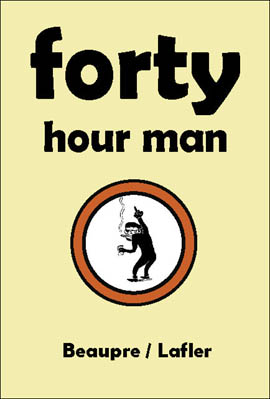
Each issue saw me contribute a short piece of my own work (including some new Dog Boy material), but the real fun for Beaupre and I was our collaboration on his Forty Hour Man. Written by Mr. Beaupre, it’s the saga of his wage slavery from teenage years to the present. Since we met as 17 year old dishwashers at the Rustler Steak House, Stephen Beaupre and I have been friends on an almost telepathic level. I was in the zone with Forty Hour Man, interpreting his narrative into a Will Elder inspired laugh fest, four pages at a time starting in Buzzard #8 and running to issue #20. The Forty Hour Man collection will appear in the summer of 2006, the first book on my new Manx Media imprint.
Meanwhile, also in Buzzard #8, I published 9 pages of my new strip, Bughouse. I was called to arms by the avatars of Bop—Miles, Bird, Sonny Rollins and Ornette Coleman—
and spurred on by visual mavericks like director David Cronenberg (The Fly, Naked Lunch). Thus inspired, I set out to create my own indigo toned, insect-noir world.
The idea of Bughouse rattled about in my head for a while. I wanted to address the nature of addiction in artists; my own slavery to beer (of all drugs), and of so many great musicians to heroin. I wanted to draw and write my way to healing my wounds and make myself whole (and it worked!). Just as important, I wanted to convey my delight in live music, the more raw and impassioned the better. I wanted to create a visual iconography to put across this gestalt of concerns.
Bughouse enjoyed a six issue run and two graphic novels as a Cat-Head Comic. And now, here is Scalawag, the third volume of Bughouse from Top Shelf Productions. With this volume, Top Shelf has all existing Bughouse material in print.
And now, for me, it’s back to the drawing board!
Steve Lafler
Portland Oregon
manxmedia@msn.com
Monday, November 28, 2005
New Dog on the Blog
I have a favorite new blog! Hey, it could be your favorite too. It's an online continuation of the feminist culture and humor zine Have You Seen the Dog Lately?
Check it out at:
http://www.haveyouseen.blogspot.com/
While I freely admit that the blogger, Serena Makofsky, is my wife, no one will argue that she is anything but a fine writer, humorist and commentator. She is a published author of short fiction, and a former professional travel journalist.
One recent evening I was extolling the virtues of www.blogger.com to her. I peeked up from my book maybe a half hour later and she already had her blog up and running. Check it out!
Check it out at:
http://www.haveyouseen.blogspot.com/
While I freely admit that the blogger, Serena Makofsky, is my wife, no one will argue that she is anything but a fine writer, humorist and commentator. She is a published author of short fiction, and a former professional travel journalist.
One recent evening I was extolling the virtues of www.blogger.com to her. I peeked up from my book maybe a half hour later and she already had her blog up and running. Check it out!
Thursday, November 17, 2005
The Direct Market is Such A Bore.
Anyone out there in the indie/alt comic book business? I've been in the game since '81. Seen my share of ups and downs in the so-called direct market, where publishers sell to specialty comic book distributors and stores.
To say it's an ingrown turd of a market is to belabor the obvoius. It's just boring and no fun. Mostly the same old-same old pointed at a peculiar smallish sub market. What passes for "cool" is so often lame, mainstream and shallow. Yeah, the kind of stuff I thought was cool too when I was fourteen years old!
The market's only saving grace is that a relative few great artists can survive and thrive with at least part of their career parked there. I'm thinking anyone from Dan Clowes to Joe Sacco to Phoebe Gloeckner, stick your favorite half decent cartoonist's name here.
For my own part, I've had comic books and graphic novels move through the "direct market" with varying degrees of sales and notoriety. I freely admit to feeling sour about the lack of sales for my trilogy of BugHouse graphic novels from Top Shelf. Certainly I'm not alone among artists with (intact) self esteem who, having put their works into this market, are disappointed with sales figures.
Okay Mr. Sour Goddamn Grapes, what's to be done??? You got a better idea? What do you propose?
First, no need to burn your bridges. Keep a toe in the direct market wading pool with future publications.
That being said, pretend that the aforementioned specialty market doesn't exist. Cool! This calls for a plan. In fact, how about a complete manifesto? Why not!
Manx Manifesto
1. Art should challenge received notions held by the public, in particular strictly defined elites, styles or cliques within the medium/discipline that the artist is working in.
2. The artist should not be bound by any established convention in their field; they are free to smash convention or use any mutation of convention in the execution of their ideas.
3. The public face, delivery and media notion of a work of art, be it object or performance, is recognized as part of the art itself.
4. The conceptual (business) model of the artists engagement with the world, through business activities such as publishing, gallery shows, public performance and such should be subjected to the same creative process as the actual art itself.
4.5. The artist shall engage in keeping accurate accounts of their income and expenses. Also known as "basic accounting".
5. The artist should follow their own personal inspiration and heart, to belabor the obvious. The artist should avoid being trapped by the dogma of others opinions, as Steven Jobs recently said.
Tips & clues--If the preceding appears opaque, oblique or prosaic to you, try the following:
A) Divest yourself of any beliefs or assumptions about the nature of reality.
B) Turn off your internal dialog.
C) Be.
Got that? Good. Now read the Manx Manifesto again. Better yet, don't. Just stick to the tips & clues.
I'm publishing now under the imprint Manx Media, and will proceed in tune with my manifesto.
Manx will release Forty Hour Man in July 2006. Stephen Beaupre wrote it and I drew it. This volume collects the strip that ran in Buzzard comics anthology over 13 issues, with 24 new pages, the perfect book for anyone who has ever had a shitty job--hey, that's pretty much everyone!
It will be a 272 page trade paperback retailing for $16.99. ISBN 0-9769690-0-9
Also next summer, Manx will release (you guessed it) Manx #1, the first issue of my new comic book. Should be about 50 saddle stitched pages, perhaps with a screen printed cover. It's gonna be a fucking art object. It's written and almost half drawn. No need to talk too much now about this one, suffice to say there will be a tour and it will be wild.
Steve Lafler
http://www.stevelafler.net
Tuesday, November 01, 2005
Ain't the Library Great?
Libraries are the type of institution that the founding fathers musta had in mind when they were looking to establish a viable democracy. Your local library is so many things; not only is it full of great ficiton, non-fiction, childrens and reference books, but it serves as a community resource as follows:
1. Information for job seekers
2. Information about colleges, universtities, and vocational schools.
3. Public access to the internet.
4. Available public space for formal meetings.
5. The "third place", not work or home, that Starbucks aspires to be (but isn't).
Those are a few library uses that I can remember. Without further ado, here is my current library anecdote.
We've been going weekly to score books for my son Max, who is four. Life is much more interesting with a constant flow of books through our lives! Thus, the library. Naturally, Serena and I grab reading material for ourselves when we are there too. So, I pick up "The Complete Idiots Guide to Growing Your Business With Google".
Huh? My business needs a web site???? All my web energy so far has been pitched towards maintaining a decent site for my cartoon/comic book business. I always had enough T-Shirt clients that it did not matter if I had a site.
NO MORE! With my move from Oakland to Portland this year, ME NEED CLIENTS! So, Manx Media needs a T-Shirt web site. It took this book to bonk me on the noggin' and see how I could make it really work, in terms of generating clients, putting up a site that makes good use of google resources for business sites.
SEE THE RESULT: Yes, another stupid web site to look at!
http://www.manxmedia.com
1. Information for job seekers
2. Information about colleges, universtities, and vocational schools.
3. Public access to the internet.
4. Available public space for formal meetings.
5. The "third place", not work or home, that Starbucks aspires to be (but isn't).
Those are a few library uses that I can remember. Without further ado, here is my current library anecdote.
We've been going weekly to score books for my son Max, who is four. Life is much more interesting with a constant flow of books through our lives! Thus, the library. Naturally, Serena and I grab reading material for ourselves when we are there too. So, I pick up "The Complete Idiots Guide to Growing Your Business With Google".
Huh? My business needs a web site???? All my web energy so far has been pitched towards maintaining a decent site for my cartoon/comic book business. I always had enough T-Shirt clients that it did not matter if I had a site.
NO MORE! With my move from Oakland to Portland this year, ME NEED CLIENTS! So, Manx Media needs a T-Shirt web site. It took this book to bonk me on the noggin' and see how I could make it really work, in terms of generating clients, putting up a site that makes good use of google resources for business sites.
SEE THE RESULT: Yes, another stupid web site to look at!
http://www.manxmedia.com
Tuesday, October 25, 2005
Manx Media: Sweeping the Ocean (just like the mud shark did)

Okay, I suppose the preceding post begs the question, what is Manx Media?
It's my new business name; I want to return to publishing comic books and graphic novels, yet I still operate my custom t-shirt printing business. Thus I have a new umbrella name for all my business adventures.
Hats off to Francis Vincent Zappa for inspiring me with a silly song name, Manx Needs Women.
Hats off to Frank just for being Frank, too.
Monday, October 24, 2005
Comics News from Manx Media
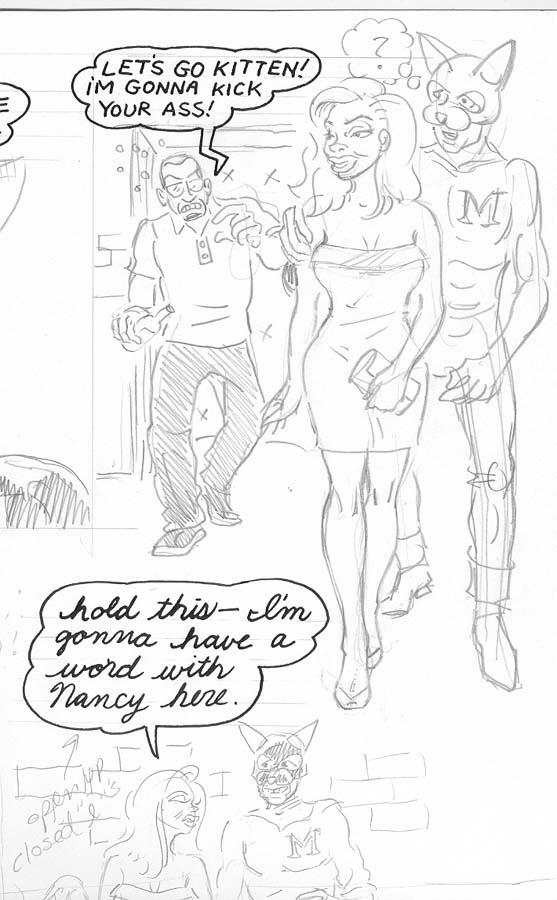
The big news from me on the comics front is that I am done with Bughouse. I've published three "Bughouse" graphic novels with Top Shelf; I've mined a very rich vein of material, and now it's done!
So, after recharging my creative batteries, I have begun drawing and writing a new body of work. It features a tongue in cheek character called Manx, a guy who goes clubbing in a cat suit! Manx is not a superhero so much as an explorer of the nether regions of human consciousness.
In the tradition of fictional work by such writers as Henry Miller and Paul Theroux, this character's alter ego is named after the author (that's me!). So, when Manx is not prowling the night in his cat suit, he is actually Steve Lafler! This will confuse some as they will indeed see it as straight up autobio, which I assure you in advance, it is not!
I just started working on this material, so with any luck, and some hard work, I'll have something in print by summer 2006. We shall see!
Meanwhile, anyone who wishes to pick up a copy of Bughouse, Baja or Scalawag (my existing graphic novels) can do so by visiting http://www.stevelafler.net
Tuesday, October 11, 2005
My Socialist Experiment – A Tale of Give and Take Between Best Friends
Yes, it’s true, I have lived the dream! In the fall of 1979, I was officially admitted to a cooperative living arrangement at the “Hadley House”, a beat up, very charming old house in Hadley, Massachusetts, tucked between the academic burghs of Amherst and Norhtampton. The idea was to share household expenses and work while upholding the socialist and feminist ideals then in vogue with college students. A big influence locally was the University of Massachusetts economics department—one housemate, Michael Hilliard, was sprinting his way through the undergraduate program quickly and efficiently, bound for grad school, and ultimately the academic life (Michael is now an economics professor in Portland, Maine).
As a freshman, I had taken Economics 101 to fulfill a gut requirement at my father’s request. He had advised me to take some economics, accounting or management courses. Maybe he hoped I would major in business. Although I figured I was heading for the Art department, I indulged dad’s request. To my amazement, and ultimate delight, the professor was none other than Samuel Bowles, a brilliant proponent of economic justice who had been booted out of Harvard for his leftist leanings. The simplest fact about distribution of wealth in our society was news to me. Five percent of the people in this country own far more than 50% of the wealth, etc., etc. Stuff like that. It was the beginning of real-world awakening for a naïve suburban brat (me). After a couple weeks, dad asked me how the economics course was going. “My professor is a Marxist.” Great!
Back to Hadley House. There was room for five students. The idea was to keep the house balanced between male and female. So there would always be the slightly skewed three to two ratio. It was three women until I moved in, then it was always three guys until I moved out the following august, escaping to the west coast. I believe I was the first coop member who was not a worker at the student run veggie coop lunch restaurant in the UMass campus center called “Earth Foods”. I loved Earth Foods! You could get a huge lentil loaf and salad for two and a half bucks or something like that. Hippy Heaven! They had good veggie pizza too. I got a kick out of the serious, doctrinaire demeanor of the workers there.
Anyway, my “in” to Hadley House was my old pal Andy, who I’d known since we were ten years old. Andy was the funniest, craziest, crankiest person I knew. I didn’t like him either when we were first acquainted in fourth grade. But by sixth grade, we were tight because of our mutual love of Jack Kirby in particular and Marvel Comics in general. Andy is the guy who turned me onto Robert Crumb. He showed me Uneeda comics, one of the most frankly sexual comics Crumb has done. Sadly, I borrowed it from Andy and my dad confiscated it, never to return. But my brother, one year older, and I got quite a graphic eyeful from that comic as junior high students.
So the other members of the coop aren’t too sure about inviting ‘ol Steve to join the commune. Sure, I’m friends with Andy, but am I a vegetarian? No meat in Hadley House! Indeed, Fran (another Earth Foods alumnus) was against me coming in, as she didn’t know me and was suspicious. She was going through her own drama, and was on her way to living as a separatist feminist. You have to be voted into the house, and my commie vegetarian credentials are in serious doubt. After all, isn’t this the infamous campus cartoonist who drew a typical Joe college farting uncontrollably after eating lunch at Earth Foods? The same John Bircher who penned a cartoon making fun of Prof. Sam Bowles himself? Guilty, guilty, guilty! Except for the John Birch part. My entrance into Hadley House society came down to whether Andy could sway Michael into voting for me. He could. I was in.
Over the course of the next year, we cooked vegetarian, bought food from, and contributed labor to the Amherst Food Coop (my job was cutting the cheese, no lie!), and fought over which girls to vote into the house when an opening came up. Andy started dating someone named Jill, a smooth talking pre-law student, and stirred quite a brouhaha when she cooked him a chicken dinner in the house one night! Michael, Andy and I engaged in a cooperative transportation experiment when we bought our landlord Doron’s beat to shit Ford Pinto off him for $200.00 bucks, and took turns running out of gas. Michael did a good job handling the heating oil bill, while I failed with the phone bill, resulting in service being shut off. Andy and I were concerned to bring out Michael’s fun side (he was obsessed with his academic work and Hegelian theory), we made sure he ate an ever increasing amount of blotter acid as the year progressed! All in all, a really good time was had by all while we learned a bit about shared responsibility.
With this Marxist indoctrination behind me, I embarked on a socialist work experiment when I opened my screen printing shop in Oakland in the spring of ’87. I was coming off about a half year period where I had earned most of my living from my Dog Boy comics, then being published by Fantagraphics. As the so called “black & whites” comics market caved in that spring, I decided I better go back to screen printing T-shirts as a back up. But I didn’t want to give up my cartooning life, so I hit on the idea of taking on a production worker to run the press. I would concentrate on marketing the service and handling the logistics of producing the jobs, thus keeping a big part of my schedule open for drawing comics. My idea was that the press operator and I would split the profits 50/50 after expenses. That way, they would get a fair share of the fruits of their labor, while I would get a highly motivated individual to produce jobs for me. My reasoning was that the worker would do a good job, as they were making an owners share of the profit. The system worked, by and large, but to say that I was naïve about how it would work is an understatement.
I invited my friend Rolf, a promising painter, to join me and run the press. He did, and for eighteen years we have worked together, splitting the profits. We are now splitting up the assets of the shop, as I am moving to Portland and he will remain in Oakland. We have both consistently made decent money for the amount of work involved.
That being said, here is where I made my miscalculation. I expected Rolf would respond to the shared work/shared profits arrangement with the same enthusiasm I had. I did not recognize he would have a different idea than I of how the working world is organized. As I am someone who is not comfortable having a job, it’s hard for me to see that most people are not comfortable doing contract/freelance work. Being more risk averse than I, Rolf has maintained a permanent part time job throughout our business relationship. He prints shirts in the shop on Fridays, and will pull shifts in the early morning, and occasionally on weekends, when the shop gets very busy.
As the business grew, and Rolf maintained his part time job, it became necessary for me to operate the press on a regular basis. This bit into my cartooning time, subverting the reason I looked for help to begin with. Ultimately, I solved the problem by hiring other printers to work Monday through Thursday, leaving just enough room in my schedule to get some artwork done. This was tough also, as I couldn’t afford to offer anyone a truly steady job. Rolf was drawing just enough cash out of the business to prevent me funding a full job for another person.
I provided employment for Rolf that fairly compensated him for the services provided. Over the years since ’87, he’s averaged more than $50.00 / hour for his press work, not bad. As we dissolve our business relationship, he is walking away with more than a dozen viable accounts, a great client list to start on his own with. We have had bumps in the ride, negotiating the terms of our arrangement along the way, but we both worked hard and pulled decent money from the shop. I am proud of this, and I believe Rolf is too.
For my own part, it was frustrating to realize, a few years in, that Rolf was not going to evolve into a full time press operator, running all the jobs I sold. Indeed, he made it clear he did not like the work, considering screen printing physically demanding and rather nasty, what with the ink and solvent involved. While that is true enough, I had a production problem to solve. I had to step up to the plate and assume control over more and more production, until it was pretty much my show, with Rolf as an able adjunct in a more minor role.
Although it slowed my progress, being unable to afford a full time worker with Rolf in the picture, I remained loyal to him. As a friend, and as a matter of honoring my word, I didn’t feel it would be right to rescind my offer of part ownership in the business. I had to respect that Rolf was finding his own comfortable level of involvement. I have been conflicted over this. Part of me considers that I have learned valuable lessons in living and in human nature with my involvement in this business relationship, while part of me wonders, why did I sacrifice my time to honor this cooperative experiment that clearly didn’t pan out for me?
Certainly, I believe that it is in the best interest of my business to pay my press operator well and treat them with respect. However, when I move to Portland, I will be hiring a press operator rather that seeking a partner. My challenge will be to create a decent job for one person, and to be sure to serve my own needs at the same time. So, you ask, where the hell did Steve’s purported socialist ideals go??? Bottom line, I’ll say it again. I’m in the position to create one job, so my goal is to make it a decent one. What does that mean? First and maybe foremost, it means above average pay. Many shops try to pull too much profit out of their labor force. This results in a bad vibe amongst the troops. Why work hard when the boss is a greedy asshole? Indeed! So figure out what the industry average is in your town, and pay more. You will get more loyal workers who will do a better job. This helps foster a good esprit de corps, but it’s still the boss’ responsibility to set the tone of mutual respect and mutual integrity.
As for my socialist ideals, how about this list from the Green Party. It sounds good, it’d be a tall order to live up to it, but it’s sure worth a try:
Ten Key Values of the Green Party
1. Grassroots Democracy
2. Social Justice
3. Ecological Wisdom
4. Non-violence
5. Decentralization
6. Economic Justice
7. Gender Equity
8. Respect for Diversity
9. Personal & Global Responsibility
10. Future Focus & Sustainability
As a freshman, I had taken Economics 101 to fulfill a gut requirement at my father’s request. He had advised me to take some economics, accounting or management courses. Maybe he hoped I would major in business. Although I figured I was heading for the Art department, I indulged dad’s request. To my amazement, and ultimate delight, the professor was none other than Samuel Bowles, a brilliant proponent of economic justice who had been booted out of Harvard for his leftist leanings. The simplest fact about distribution of wealth in our society was news to me. Five percent of the people in this country own far more than 50% of the wealth, etc., etc. Stuff like that. It was the beginning of real-world awakening for a naïve suburban brat (me). After a couple weeks, dad asked me how the economics course was going. “My professor is a Marxist.” Great!
Back to Hadley House. There was room for five students. The idea was to keep the house balanced between male and female. So there would always be the slightly skewed three to two ratio. It was three women until I moved in, then it was always three guys until I moved out the following august, escaping to the west coast. I believe I was the first coop member who was not a worker at the student run veggie coop lunch restaurant in the UMass campus center called “Earth Foods”. I loved Earth Foods! You could get a huge lentil loaf and salad for two and a half bucks or something like that. Hippy Heaven! They had good veggie pizza too. I got a kick out of the serious, doctrinaire demeanor of the workers there.
Anyway, my “in” to Hadley House was my old pal Andy, who I’d known since we were ten years old. Andy was the funniest, craziest, crankiest person I knew. I didn’t like him either when we were first acquainted in fourth grade. But by sixth grade, we were tight because of our mutual love of Jack Kirby in particular and Marvel Comics in general. Andy is the guy who turned me onto Robert Crumb. He showed me Uneeda comics, one of the most frankly sexual comics Crumb has done. Sadly, I borrowed it from Andy and my dad confiscated it, never to return. But my brother, one year older, and I got quite a graphic eyeful from that comic as junior high students.
So the other members of the coop aren’t too sure about inviting ‘ol Steve to join the commune. Sure, I’m friends with Andy, but am I a vegetarian? No meat in Hadley House! Indeed, Fran (another Earth Foods alumnus) was against me coming in, as she didn’t know me and was suspicious. She was going through her own drama, and was on her way to living as a separatist feminist. You have to be voted into the house, and my commie vegetarian credentials are in serious doubt. After all, isn’t this the infamous campus cartoonist who drew a typical Joe college farting uncontrollably after eating lunch at Earth Foods? The same John Bircher who penned a cartoon making fun of Prof. Sam Bowles himself? Guilty, guilty, guilty! Except for the John Birch part. My entrance into Hadley House society came down to whether Andy could sway Michael into voting for me. He could. I was in.
Over the course of the next year, we cooked vegetarian, bought food from, and contributed labor to the Amherst Food Coop (my job was cutting the cheese, no lie!), and fought over which girls to vote into the house when an opening came up. Andy started dating someone named Jill, a smooth talking pre-law student, and stirred quite a brouhaha when she cooked him a chicken dinner in the house one night! Michael, Andy and I engaged in a cooperative transportation experiment when we bought our landlord Doron’s beat to shit Ford Pinto off him for $200.00 bucks, and took turns running out of gas. Michael did a good job handling the heating oil bill, while I failed with the phone bill, resulting in service being shut off. Andy and I were concerned to bring out Michael’s fun side (he was obsessed with his academic work and Hegelian theory), we made sure he ate an ever increasing amount of blotter acid as the year progressed! All in all, a really good time was had by all while we learned a bit about shared responsibility.
With this Marxist indoctrination behind me, I embarked on a socialist work experiment when I opened my screen printing shop in Oakland in the spring of ’87. I was coming off about a half year period where I had earned most of my living from my Dog Boy comics, then being published by Fantagraphics. As the so called “black & whites” comics market caved in that spring, I decided I better go back to screen printing T-shirts as a back up. But I didn’t want to give up my cartooning life, so I hit on the idea of taking on a production worker to run the press. I would concentrate on marketing the service and handling the logistics of producing the jobs, thus keeping a big part of my schedule open for drawing comics. My idea was that the press operator and I would split the profits 50/50 after expenses. That way, they would get a fair share of the fruits of their labor, while I would get a highly motivated individual to produce jobs for me. My reasoning was that the worker would do a good job, as they were making an owners share of the profit. The system worked, by and large, but to say that I was naïve about how it would work is an understatement.
I invited my friend Rolf, a promising painter, to join me and run the press. He did, and for eighteen years we have worked together, splitting the profits. We are now splitting up the assets of the shop, as I am moving to Portland and he will remain in Oakland. We have both consistently made decent money for the amount of work involved.
That being said, here is where I made my miscalculation. I expected Rolf would respond to the shared work/shared profits arrangement with the same enthusiasm I had. I did not recognize he would have a different idea than I of how the working world is organized. As I am someone who is not comfortable having a job, it’s hard for me to see that most people are not comfortable doing contract/freelance work. Being more risk averse than I, Rolf has maintained a permanent part time job throughout our business relationship. He prints shirts in the shop on Fridays, and will pull shifts in the early morning, and occasionally on weekends, when the shop gets very busy.
As the business grew, and Rolf maintained his part time job, it became necessary for me to operate the press on a regular basis. This bit into my cartooning time, subverting the reason I looked for help to begin with. Ultimately, I solved the problem by hiring other printers to work Monday through Thursday, leaving just enough room in my schedule to get some artwork done. This was tough also, as I couldn’t afford to offer anyone a truly steady job. Rolf was drawing just enough cash out of the business to prevent me funding a full job for another person.
I provided employment for Rolf that fairly compensated him for the services provided. Over the years since ’87, he’s averaged more than $50.00 / hour for his press work, not bad. As we dissolve our business relationship, he is walking away with more than a dozen viable accounts, a great client list to start on his own with. We have had bumps in the ride, negotiating the terms of our arrangement along the way, but we both worked hard and pulled decent money from the shop. I am proud of this, and I believe Rolf is too.
For my own part, it was frustrating to realize, a few years in, that Rolf was not going to evolve into a full time press operator, running all the jobs I sold. Indeed, he made it clear he did not like the work, considering screen printing physically demanding and rather nasty, what with the ink and solvent involved. While that is true enough, I had a production problem to solve. I had to step up to the plate and assume control over more and more production, until it was pretty much my show, with Rolf as an able adjunct in a more minor role.
Although it slowed my progress, being unable to afford a full time worker with Rolf in the picture, I remained loyal to him. As a friend, and as a matter of honoring my word, I didn’t feel it would be right to rescind my offer of part ownership in the business. I had to respect that Rolf was finding his own comfortable level of involvement. I have been conflicted over this. Part of me considers that I have learned valuable lessons in living and in human nature with my involvement in this business relationship, while part of me wonders, why did I sacrifice my time to honor this cooperative experiment that clearly didn’t pan out for me?
Certainly, I believe that it is in the best interest of my business to pay my press operator well and treat them with respect. However, when I move to Portland, I will be hiring a press operator rather that seeking a partner. My challenge will be to create a decent job for one person, and to be sure to serve my own needs at the same time. So, you ask, where the hell did Steve’s purported socialist ideals go??? Bottom line, I’ll say it again. I’m in the position to create one job, so my goal is to make it a decent one. What does that mean? First and maybe foremost, it means above average pay. Many shops try to pull too much profit out of their labor force. This results in a bad vibe amongst the troops. Why work hard when the boss is a greedy asshole? Indeed! So figure out what the industry average is in your town, and pay more. You will get more loyal workers who will do a better job. This helps foster a good esprit de corps, but it’s still the boss’ responsibility to set the tone of mutual respect and mutual integrity.
As for my socialist ideals, how about this list from the Green Party. It sounds good, it’d be a tall order to live up to it, but it’s sure worth a try:
Ten Key Values of the Green Party
1. Grassroots Democracy
2. Social Justice
3. Ecological Wisdom
4. Non-violence
5. Decentralization
6. Economic Justice
7. Gender Equity
8. Respect for Diversity
9. Personal & Global Responsibility
10. Future Focus & Sustainability
Thursday, October 06, 2005
To Job or Not to Job?
"But what about the benefits? The pension? The security?"
These are the questions asked by the proponents of throwing in the towel on self employment and getting a regular job. No, let me rephrase that. These are the questions asked of me by those whose lives are ruled by fear of the future and the unknown. As such, they are driven to ask me questions that really have an underlying assumption: The assumption that I share their values and beliefs about jobs and the working life. The assumption that their dogma is my dogma. It ain't.
I have never been a person who has been inclined to be trapped by O.P.T. (other people's thinking). I reckon I fancy myself a maverick. In any case, I've almost always followed my own heart and intuition when it comes to decisions about my work life (I'm slightly allergic to the word "career"). I know myself; my beliefs and mode of being make self employment not just an elegant choice for me; it's the only choice for me. I have in fact had jobs. I'm here to tell you, I hated every minute of it.
But what about the Benefits? the Pension? the Security?
First and foremost, to me, it just ain't worth having that particular log shoved up your ass known as A JOB. I just can't trade away control over my time and life for what is offered in return. But in fairness, I will address each of these concerns.
Benefits; the health plan that my family has, Kaiser Permanente, is decent. It's also expensive. But as I am established in business, it is an affordable prospect for me. I split it with my wife. We can debate the fairness of that, but it makes my contribution very do-able.
If one is just starting in business, health care could be a tough expense to make, true enough. So, I recommend the following: A) Be young and healthy when you start your self employment scheme! B) Buy a high deductable catastrophic care plan. I used to have such a plan before I was a family man, and it was very affordable.
Pension; go and start an IRA or 401K or some goddamn retirement plan yourself. Start young. Pay it every week. Or just have a savings account, put something away on a regular basis. Pay your taxes, and you will be paying into Social Security, which Bush hasn't destroyed yet. By the way, I figure it's even money that the world economic system will even exist in it's current form by the time I retire. What do you think? If the glass house crashes, so does your precious retirement plan. So keep some fresh water and canned food around! And some good weed.
Security. Don't make me laugh. Where do I start? I've kept myself gainfully employed though three or four economic downturns of varying degrees of intensity. As a young man, I started my business and looked for a regular job simultaneously, early in the Reagan era. Never did get a job offer, but I sure as hell did build a successful business. Working for myself is simply unbeatable for security. I have built a cash flow engine that no one can take away from me. End of subject.
Do I seem testy on this subject? Ha ha, I am! Let's just say that my socio-ecomomic status has been commented upon lately by persons ignorant of my splendid philosophical outlook and business acumen.
These are the questions asked by the proponents of throwing in the towel on self employment and getting a regular job. No, let me rephrase that. These are the questions asked of me by those whose lives are ruled by fear of the future and the unknown. As such, they are driven to ask me questions that really have an underlying assumption: The assumption that I share their values and beliefs about jobs and the working life. The assumption that their dogma is my dogma. It ain't.
I have never been a person who has been inclined to be trapped by O.P.T. (other people's thinking). I reckon I fancy myself a maverick. In any case, I've almost always followed my own heart and intuition when it comes to decisions about my work life (I'm slightly allergic to the word "career"). I know myself; my beliefs and mode of being make self employment not just an elegant choice for me; it's the only choice for me. I have in fact had jobs. I'm here to tell you, I hated every minute of it.
But what about the Benefits? the Pension? the Security?
First and foremost, to me, it just ain't worth having that particular log shoved up your ass known as A JOB. I just can't trade away control over my time and life for what is offered in return. But in fairness, I will address each of these concerns.
Benefits; the health plan that my family has, Kaiser Permanente, is decent. It's also expensive. But as I am established in business, it is an affordable prospect for me. I split it with my wife. We can debate the fairness of that, but it makes my contribution very do-able.
If one is just starting in business, health care could be a tough expense to make, true enough. So, I recommend the following: A) Be young and healthy when you start your self employment scheme! B) Buy a high deductable catastrophic care plan. I used to have such a plan before I was a family man, and it was very affordable.
Pension; go and start an IRA or 401K or some goddamn retirement plan yourself. Start young. Pay it every week. Or just have a savings account, put something away on a regular basis. Pay your taxes, and you will be paying into Social Security, which Bush hasn't destroyed yet. By the way, I figure it's even money that the world economic system will even exist in it's current form by the time I retire. What do you think? If the glass house crashes, so does your precious retirement plan. So keep some fresh water and canned food around! And some good weed.
Security. Don't make me laugh. Where do I start? I've kept myself gainfully employed though three or four economic downturns of varying degrees of intensity. As a young man, I started my business and looked for a regular job simultaneously, early in the Reagan era. Never did get a job offer, but I sure as hell did build a successful business. Working for myself is simply unbeatable for security. I have built a cash flow engine that no one can take away from me. End of subject.
Do I seem testy on this subject? Ha ha, I am! Let's just say that my socio-ecomomic status has been commented upon lately by persons ignorant of my splendid philosophical outlook and business acumen.
Wednesday, September 28, 2005
Letter to Dennis
I recently wrote a letter to a friend on mine describing an experience that I had on April 10, 1976. Make of it what you will.
By the way, it's safe to say that this piece is a bit out of the perview of "Self Employment for Bohemians", but on the other hand, the events of that day have informed almost everything I have done as a worker and artist since.
YO Dennis,
Ha ha, you noticed that bit about the "singularity of the eternal now". What I know about that, I was told by a mushroom. No kidding.
It was quite a set up. When I was a freshman in college, Beaupre and one other friend and I ate some 'shrooms. I'd never tripped before. It was all fun and games, but after awhile it was clear I was way fucking higher than the other guys.
The clue was, Beaupre and the other fella seemed frozen on the couch; they looked like jagged outlines of themselves, pixelated into jumbled shards of color. Their eyes, however, remained constant, even piercing, and were alive and alien. They spoke to me through their eyes, without sound. They said something like "Steve and Rob have consented to let us use their bodies for a few minutes to speak to you. We are ancient travelers, and not from here (earth). We are going to tell you some secrets that are gonna kick your ass, that all people know, but few remember".
That was the intro. For the next hour maybe, the peak of the trip, I had an experience of dying, and splitting into possibly millions of shards of light, each one representing a life, or at least some separate energy field. I had to become each of them, immersed in time, they I had to be born as myself again, live my nineteen years again, to get back to where I started.
As I wove in and out of these lives over several eternities, the basic idea I was left with is that all our lives exist at once, that is, simultaneously. They are separated by a matter of electrical pitch or frequency, or some form of focus in a specific location in physical reality. But time, linear time as we think of it, simply does not exist. It is a construct of human comprehension of the physical system we are immersed in.
As it is always the present, there is indeed only one moment, a singularity if you will, out of which constantly emerges what we perceive as physical reality.
The constant property of the singularity is change; these changes we record as "history", or a notion of linear time.
Considering the nature of change, I propose that the motive force behind all action is creative curiosity, a will to have fun. If we're lucky, really lucky, we could define that will to have fun as "love". I'd like to think we're that lucky, but I'm not sure.
The other good news, I believe, is that when human beings wake up to the true nature of "time" in some fundamental way, we will realize that we are indeed capable of solving our knottiest problems, as a lot of received "knowledge" will drop away like last week's cheese.
Hey, you asked for it buddy!The mushrooms did indeed present themselves to me as interstellar sage/tricksters who really enjoy having a laugh at the expense of a rube like me.
By the way, it's safe to say that this piece is a bit out of the perview of "Self Employment for Bohemians", but on the other hand, the events of that day have informed almost everything I have done as a worker and artist since.
YO Dennis,
Ha ha, you noticed that bit about the "singularity of the eternal now". What I know about that, I was told by a mushroom. No kidding.
It was quite a set up. When I was a freshman in college, Beaupre and one other friend and I ate some 'shrooms. I'd never tripped before. It was all fun and games, but after awhile it was clear I was way fucking higher than the other guys.
The clue was, Beaupre and the other fella seemed frozen on the couch; they looked like jagged outlines of themselves, pixelated into jumbled shards of color. Their eyes, however, remained constant, even piercing, and were alive and alien. They spoke to me through their eyes, without sound. They said something like "Steve and Rob have consented to let us use their bodies for a few minutes to speak to you. We are ancient travelers, and not from here (earth). We are going to tell you some secrets that are gonna kick your ass, that all people know, but few remember".
That was the intro. For the next hour maybe, the peak of the trip, I had an experience of dying, and splitting into possibly millions of shards of light, each one representing a life, or at least some separate energy field. I had to become each of them, immersed in time, they I had to be born as myself again, live my nineteen years again, to get back to where I started.
As I wove in and out of these lives over several eternities, the basic idea I was left with is that all our lives exist at once, that is, simultaneously. They are separated by a matter of electrical pitch or frequency, or some form of focus in a specific location in physical reality. But time, linear time as we think of it, simply does not exist. It is a construct of human comprehension of the physical system we are immersed in.
As it is always the present, there is indeed only one moment, a singularity if you will, out of which constantly emerges what we perceive as physical reality.
The constant property of the singularity is change; these changes we record as "history", or a notion of linear time.
Considering the nature of change, I propose that the motive force behind all action is creative curiosity, a will to have fun. If we're lucky, really lucky, we could define that will to have fun as "love". I'd like to think we're that lucky, but I'm not sure.
The other good news, I believe, is that when human beings wake up to the true nature of "time" in some fundamental way, we will realize that we are indeed capable of solving our knottiest problems, as a lot of received "knowledge" will drop away like last week's cheese.
Hey, you asked for it buddy!The mushrooms did indeed present themselves to me as interstellar sage/tricksters who really enjoy having a laugh at the expense of a rube like me.
Monday, September 05, 2005
Welcome Genevieve!

Genevieve Rosa Lafler was born September 1st at 1:09 p.m., weighing 8 pounds, 11 ounces, at 20 inches tall.
She's a red head like her dad Steve, and is gorgeous like her mom Serena!
Monday, August 29, 2005
You Want Business Tips? Why Didn't You Say So?
I know, here in my alledged business tips for boho entreprenuers blog, it would seem I've been going on about my brilliant cartoon career. Guilty as charged, I get carried away sometimes. What an ego!
Okay, you want business tips? We gots 'em, in spades. Some may remember that way back when (last winter or so), I advised that one should always seek the win-win deal. Part of that approach is treating each and every person you encounter in the course of your business life with respect. The other part is treating yourself with respect.
Self respect is key to success as a Boho Entrepreneur. Therefore, once you are up and running, and you know what you are about, I offer the following well worn platitudes:
1. Take no prisoners.
2. Do not suffer fools gladly.
In practical terms, I suggest you institute an "jerk" fee. If you encounter a potential client where red flags pop up like mushrooms after a spring rain, add a good 25% to your job quote. Then, it will be worth it to work with someone who wants to "win" the deal, or otherwise push you around. Better yet, since they will be cheap as well as rude, and you will scare them off.
I recently quoted on a job, for a tiny fastidioius man, who was in the education field. He taught people how to be prison guards. He arrived at my house packing a .38 and a very large attitude. I do not like firearms, and I do not like people who bring firearms into my house. Especially without asking!
I was pleasant to a fault to this arrogant little turd, but I duly scared his sorry ass off with a 25% "bump" on top of my usual fee. Yup, the red flags were going off like nuts, and I scared him off. Had he gone for the quote, it would have been well worth it to deal with him at those rates.
Okay bye, I gotta go draw some more comics.
Okay, you want business tips? We gots 'em, in spades. Some may remember that way back when (last winter or so), I advised that one should always seek the win-win deal. Part of that approach is treating each and every person you encounter in the course of your business life with respect. The other part is treating yourself with respect.
Self respect is key to success as a Boho Entrepreneur. Therefore, once you are up and running, and you know what you are about, I offer the following well worn platitudes:
1. Take no prisoners.
2. Do not suffer fools gladly.
In practical terms, I suggest you institute an "jerk" fee. If you encounter a potential client where red flags pop up like mushrooms after a spring rain, add a good 25% to your job quote. Then, it will be worth it to work with someone who wants to "win" the deal, or otherwise push you around. Better yet, since they will be cheap as well as rude, and you will scare them off.
I recently quoted on a job, for a tiny fastidioius man, who was in the education field. He taught people how to be prison guards. He arrived at my house packing a .38 and a very large attitude. I do not like firearms, and I do not like people who bring firearms into my house. Especially without asking!
I was pleasant to a fault to this arrogant little turd, but I duly scared his sorry ass off with a 25% "bump" on top of my usual fee. Yup, the red flags were going off like nuts, and I scared him off. Had he gone for the quote, it would have been well worth it to deal with him at those rates.
Okay bye, I gotta go draw some more comics.
Tuesday, August 09, 2005
Radio Interview - Steve's Comics

On Monday August 15th, I was interviewed on KPFA 94.1 FM, the venerable Berkeley radio station. talking about my latest graphic novel Scalawag on "Cover to Cover" with Denny Smithson.
To listen to the interview, I am placing a link here to the archive page for "Cover to Cover". Once there, click on the "Listen" button for the August 15th show.
Here's that link:
http://www.kpfa.org/archives/archives.php?id=6
Thursday, August 04, 2005
The Days Between--Celebrating Jerry


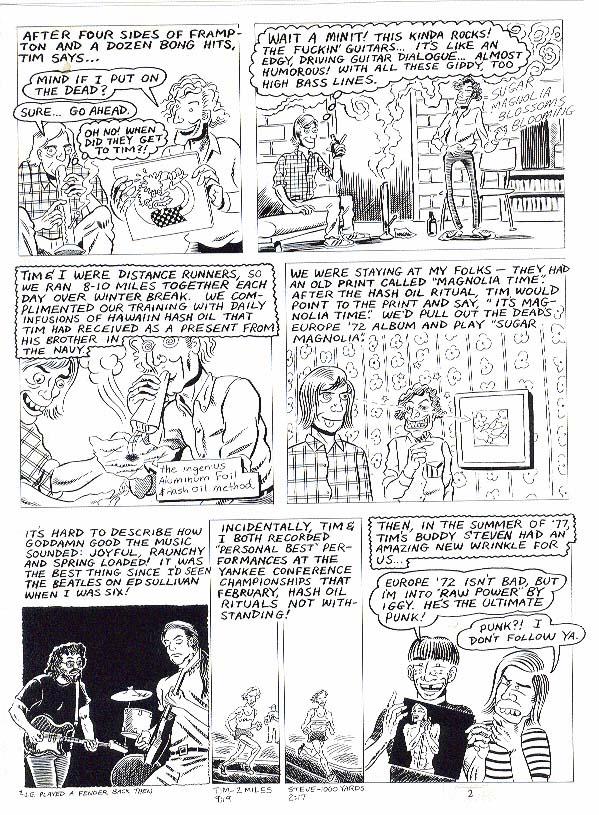

It's that time of year that some Deadheads refer to as "The Days Between", the stretch of days in the heart (and heat) of the summer that lay between August 1, Jerry Garcia's birthday, and August 9, the anniversary of his death.
I've been ruminating on the fact that it's been ten years since Jerry left us. I still miss the big guy quite a bit--what I wouldn't give to see him shuffle on to stage with his guitar for just one more magic evening (or sunny Sunday afternoon at the Greek Theatre) of impossibly gorgeous music!
No matter how many great shows I have on tape, CD or video, I want to remember that there really was nothing quite like being there--the smells of course (all that pungent weed!), the sounds, the roller coaster range of emotions the boys dragged me over, and the vacilliation of the overall tone of the event.
Many a show felt like a picnic, or a baseball game, but anyone who attended more than a few will recall that on ocassion, the curtains would seem to part on consensus reality, and the Elysian Mysteries themselves would be revealed (an image suggested by music critic Richard Gehr); all would come clear in the singularity of the moment (I admit, this level of appreciation could be aided by ingestion of mushrooms, or some clean blotter-but I attended many a flat out mind-boggling show on nothing stronger than a few hits of stinky bud).
In any case, I'm posting these comics here I created a few months after the passing of Jerry, my homage to the man and his music. I hope you enjoy. Note: Clicking on the images at the front of this entry will enlarge them in your browser.
For more info on my cartoons:
http://www.stevelafler.net
Wednesday, August 03, 2005
The Running Thing
As I was coming of age in the Nineteen Seventies, I commenced my life-long adventure as a runner. Some readers will be old enough to remember that there was something called “the Running Boom” back then, sparked to some degree by Frank Shorter’s victory in the Olympic Marathon in ’72 in Munich.
Amidst the odd cultural flux of the “me” decade, with it’s back to nature movement, and post Sixties search for meaning, being a serious runner seemed life affirming, even heroic. Many people tried the Running Thing who ultimately hated it!
These days, serious running is left to serious runners, but for a few years there, it captured the cultural zeitgeist and was part of the national scene. Top Oregon runner Steve Prefontaine, holder of numerous American records in distance events on the track, was a colorful national hero, embodying the rebellious, rugged individualist ethos of the Seventies runner. Even president Jimmy Carter was a runner!
Before it became a national craze, I used running for transportation. That’s right, transportation. As a junior high kid in a semi-bucolic suburb, I lived on my bicycle much of the year. I hail from Western Massachusetts, where winters are heavy with snow, so I was generally off the bike from December to March. Wanting still to hang with friends who lived several miles off, too young to drive, I took to plodding through the snow at a variable paced trot until I reached my destination. “Geez Steve, you’re drenched in sweat!”.
I had loved running all my life. As a five year old, P.F. Flyers advertised their sneakers on TV, promising me that I would “run faster, jump higher”. Branded! I begged my mom for a pair, and soon was running faster, and jumping higher in the back yard.
From then on, I would race at every opportunity. Always, I was convinced that I was invincible! Imagine how crestfallen I was when my cousin Kathy beat me in a dash across our back yard… of course, I was five and she was twelve—that may have been a factor.
I persevered, and when the official “field day” came in third grade, I advanced to the final of the ninety foot dash! Off to a good start, I was once more sure of victory, when this chubby kid named Albert got his stumpy legs just CHUGGIN’, and he took off like a bat outa hell. So I got second place.
Throughout grade school, suffering from the usual desire to fit in, I tried baseball, football and basketball, both on the playground, and in more official school or town sponsored settings. Although the tallest kid in the sixth grade, I was able to score only two points in a whole winter of intramural basketball! Lucky for me I could get the ‘bounds, feed them to my arch enemy/team mate Bobby Petroff, and we won our share of games.
Little League, however, was a complete bust for me. Two seasons, no hits. Okay, so I did get on base a couple times on walks. To this day, I’m unclear why I subjected myself to that ongoing torture.
Was the old self esteem affected by my failings at these traditional means of gaining stature among ones peers? Not too darn much, yet I still longed for some accomplishment at sports to prove myself with.
Jeff Campbell, my friend who lived across the street, was a year older than I. He went out for cross country upon arrival at Longmeadow High School. Although he was but an average runner, he enjoyed being on the team, the camaraderie, and the sense of accomplishment it gave him. Repeatedly, Jeff encouraged me to go out for the cross country team upon my arrival in high school. I decided it wasn’t for me! All those miles of trudging along—it sounded exhausting (of course, I was captain of my high school team by my senior year, at Lincoln Sudbury High, after my family moved closer to Boston).
Contrary to Jeff’s advice, I had figured out my own route to athletic glory. Knowing I had a lick of speed and decent endurance, I would run the half mile. It was the shortest distance that was not a sprint. I was confident that I would be good at it.
So it was that I went out for the track team at Longmeadow High School as a freshman in March of 1972. On that first day, my best friends, Steve Cimini and Paul Lewia, speed merchants both, attempted to convince me join them in the sprinter group. Knowing better, I went with the distance guys. Lewia screwed up his face, telling me I was making a mistake.
From the first workouts under the watchful eye of Mr. Winseck (the coach, also a history teacher), I could barely believe how hard it was. The “interval” workouts were agony, leaving me with sore, sore legs, and a stomach ache. Running these workouts was near impossible, with the intense oxygen debt induced. All the while, Mr. Winseck, a Paul Lynde lookalike with a high pitched voice, would scream, “Come on Lafler, you’re doggin’ it.”. My pal Lewia did a great Mr. Winseck impression.
Despite my difficulty with the workouts, I knew I was literally on the right track, as Mr. Winseck enthused, “It’s nice to see a big strong kid like you come out for the team”. Huh? You talkin’ to me?
Gauging my stride during workouts, Mr. Winseck announced to me that I would be running the mile, not the half. My heart sank at the prospect of having to run hard for such an enormous distance!
But the guy knew his stuff. Not only did I win the event late that season at a big three way junior varsity meet, leading almost post to post, but I actually made the varsity team as a freshman, placing third in my very first high school track meet! I was off and running, as they say.
Back then, I was in it for whatever glory I could pluck from the arena of high school track competition. Running fast, running hard was difficult, and I didn’t see myself doing any serious running after high school; hell, I wasn’t even sure I would run all through high school! I did not know that running would become key to my mental and physical well being. I did not know that I would come to regard running as a rhythmic breathing meditation that could help me solve sticky problems, and calm my nerves. I didn’t know that, invariably, when I stepped out the door for a run I would come back refreshed, literally feeling better than when I started. And the much touted “runners high”; for me it clicks in about 30 – 35 minutes into the run, and from there on out, I am floating on air.
As a twenty year old college kid, between the indoor track and spring track seasons, a moment stands out. On run from my parents’ house in Sudbury, Massachusetts, winding down a wooded New England road, the March sun gathers itself for a peek through the still-bare trees. There is the earliest hint of green grass coming back for spring, the moisture from melting snow smiles on the pavement under the friendly sun.
I’ve been running for several miles already; turning over my latest problems in my mind. School, money, girls, car, all the dumb stuff a twenty year old worries about. As I get loose, the worries drift away, assuming their proper smallish stature in my mind.
The late afternoon, late winter, New England light, the warm air, the suddenly flat stretch of road, mix with the easy rhythm of running. Unconsciously I pick up the pace, it’s effortless.
Although I am all awareness, all action, a small part of me is still thinking in words, informing me: “I’m running almost as fast as I can, and it’s effortless; I could keep this up for miles”. And that’s just what I did, continuing back to my mom and dad’s place at a pace somewhat less than five minutes per mile, finally feeling the effort, the strain over the last few minutes, celebrating by picking up the tempo even more, and ending with a flat out sprint over the last few hundred yards, followed by a yell of pure joy in the act of running.
In due course I became a decent high school runner, spurred on by the sterling example of a plucky kid from Wayland, the town next to Sudbury. This kid, one Alberto Salazar, had the nerve to cover two miles at the same pace I had managed for one!
Later as a collegiate runner I won just a few races, as the hedonism of the Seventies and my emergent interest in art-making took over. My ego and self esteem would slide up and down with my fortunes on the track as a young man, until I realized my true talents lay in other areas. Then I was free to simply run.
Competition aside, I always suspected, and have long since confirmed, that I was not really in it for the glory—no, for me it’s the moments of transcendence, the beauty of the experience of the moment, that are meaningful in running. Sure, I still like to get fit and compete, but it’s more process than goal oriented at this juncture (but do look out if there is less than 200 to go, and I’m running next to you!).
“I am running” is a phrase meaning you are engaged in the physical act of running, but it is may also be used to describe a state of being.
Steve Lafler ©2005
Amidst the odd cultural flux of the “me” decade, with it’s back to nature movement, and post Sixties search for meaning, being a serious runner seemed life affirming, even heroic. Many people tried the Running Thing who ultimately hated it!
These days, serious running is left to serious runners, but for a few years there, it captured the cultural zeitgeist and was part of the national scene. Top Oregon runner Steve Prefontaine, holder of numerous American records in distance events on the track, was a colorful national hero, embodying the rebellious, rugged individualist ethos of the Seventies runner. Even president Jimmy Carter was a runner!
Before it became a national craze, I used running for transportation. That’s right, transportation. As a junior high kid in a semi-bucolic suburb, I lived on my bicycle much of the year. I hail from Western Massachusetts, where winters are heavy with snow, so I was generally off the bike from December to March. Wanting still to hang with friends who lived several miles off, too young to drive, I took to plodding through the snow at a variable paced trot until I reached my destination. “Geez Steve, you’re drenched in sweat!”.
I had loved running all my life. As a five year old, P.F. Flyers advertised their sneakers on TV, promising me that I would “run faster, jump higher”. Branded! I begged my mom for a pair, and soon was running faster, and jumping higher in the back yard.
From then on, I would race at every opportunity. Always, I was convinced that I was invincible! Imagine how crestfallen I was when my cousin Kathy beat me in a dash across our back yard… of course, I was five and she was twelve—that may have been a factor.
I persevered, and when the official “field day” came in third grade, I advanced to the final of the ninety foot dash! Off to a good start, I was once more sure of victory, when this chubby kid named Albert got his stumpy legs just CHUGGIN’, and he took off like a bat outa hell. So I got second place.
Throughout grade school, suffering from the usual desire to fit in, I tried baseball, football and basketball, both on the playground, and in more official school or town sponsored settings. Although the tallest kid in the sixth grade, I was able to score only two points in a whole winter of intramural basketball! Lucky for me I could get the ‘bounds, feed them to my arch enemy/team mate Bobby Petroff, and we won our share of games.
Little League, however, was a complete bust for me. Two seasons, no hits. Okay, so I did get on base a couple times on walks. To this day, I’m unclear why I subjected myself to that ongoing torture.
Was the old self esteem affected by my failings at these traditional means of gaining stature among ones peers? Not too darn much, yet I still longed for some accomplishment at sports to prove myself with.
Jeff Campbell, my friend who lived across the street, was a year older than I. He went out for cross country upon arrival at Longmeadow High School. Although he was but an average runner, he enjoyed being on the team, the camaraderie, and the sense of accomplishment it gave him. Repeatedly, Jeff encouraged me to go out for the cross country team upon my arrival in high school. I decided it wasn’t for me! All those miles of trudging along—it sounded exhausting (of course, I was captain of my high school team by my senior year, at Lincoln Sudbury High, after my family moved closer to Boston).
Contrary to Jeff’s advice, I had figured out my own route to athletic glory. Knowing I had a lick of speed and decent endurance, I would run the half mile. It was the shortest distance that was not a sprint. I was confident that I would be good at it.
So it was that I went out for the track team at Longmeadow High School as a freshman in March of 1972. On that first day, my best friends, Steve Cimini and Paul Lewia, speed merchants both, attempted to convince me join them in the sprinter group. Knowing better, I went with the distance guys. Lewia screwed up his face, telling me I was making a mistake.
From the first workouts under the watchful eye of Mr. Winseck (the coach, also a history teacher), I could barely believe how hard it was. The “interval” workouts were agony, leaving me with sore, sore legs, and a stomach ache. Running these workouts was near impossible, with the intense oxygen debt induced. All the while, Mr. Winseck, a Paul Lynde lookalike with a high pitched voice, would scream, “Come on Lafler, you’re doggin’ it.”. My pal Lewia did a great Mr. Winseck impression.
Despite my difficulty with the workouts, I knew I was literally on the right track, as Mr. Winseck enthused, “It’s nice to see a big strong kid like you come out for the team”. Huh? You talkin’ to me?
Gauging my stride during workouts, Mr. Winseck announced to me that I would be running the mile, not the half. My heart sank at the prospect of having to run hard for such an enormous distance!
But the guy knew his stuff. Not only did I win the event late that season at a big three way junior varsity meet, leading almost post to post, but I actually made the varsity team as a freshman, placing third in my very first high school track meet! I was off and running, as they say.
Back then, I was in it for whatever glory I could pluck from the arena of high school track competition. Running fast, running hard was difficult, and I didn’t see myself doing any serious running after high school; hell, I wasn’t even sure I would run all through high school! I did not know that running would become key to my mental and physical well being. I did not know that I would come to regard running as a rhythmic breathing meditation that could help me solve sticky problems, and calm my nerves. I didn’t know that, invariably, when I stepped out the door for a run I would come back refreshed, literally feeling better than when I started. And the much touted “runners high”; for me it clicks in about 30 – 35 minutes into the run, and from there on out, I am floating on air.
As a twenty year old college kid, between the indoor track and spring track seasons, a moment stands out. On run from my parents’ house in Sudbury, Massachusetts, winding down a wooded New England road, the March sun gathers itself for a peek through the still-bare trees. There is the earliest hint of green grass coming back for spring, the moisture from melting snow smiles on the pavement under the friendly sun.
I’ve been running for several miles already; turning over my latest problems in my mind. School, money, girls, car, all the dumb stuff a twenty year old worries about. As I get loose, the worries drift away, assuming their proper smallish stature in my mind.
The late afternoon, late winter, New England light, the warm air, the suddenly flat stretch of road, mix with the easy rhythm of running. Unconsciously I pick up the pace, it’s effortless.
Although I am all awareness, all action, a small part of me is still thinking in words, informing me: “I’m running almost as fast as I can, and it’s effortless; I could keep this up for miles”. And that’s just what I did, continuing back to my mom and dad’s place at a pace somewhat less than five minutes per mile, finally feeling the effort, the strain over the last few minutes, celebrating by picking up the tempo even more, and ending with a flat out sprint over the last few hundred yards, followed by a yell of pure joy in the act of running.
In due course I became a decent high school runner, spurred on by the sterling example of a plucky kid from Wayland, the town next to Sudbury. This kid, one Alberto Salazar, had the nerve to cover two miles at the same pace I had managed for one!
Later as a collegiate runner I won just a few races, as the hedonism of the Seventies and my emergent interest in art-making took over. My ego and self esteem would slide up and down with my fortunes on the track as a young man, until I realized my true talents lay in other areas. Then I was free to simply run.
Competition aside, I always suspected, and have long since confirmed, that I was not really in it for the glory—no, for me it’s the moments of transcendence, the beauty of the experience of the moment, that are meaningful in running. Sure, I still like to get fit and compete, but it’s more process than goal oriented at this juncture (but do look out if there is less than 200 to go, and I’m running next to you!).
“I am running” is a phrase meaning you are engaged in the physical act of running, but it is may also be used to describe a state of being.
Steve Lafler ©2005
Monday, July 11, 2005
The Weed Museum

Before I started my t-shirt business as a junior in college, I witnessed first hand the operation of the most time honored category of college dorm small business, the weed dealership.
You see, I had an enterprising friend on my floor, let’s call him Bert. Along with just about everyone else in the fall of ’76 in the giant “Southwest” high-rise dorm complex at UMass, Bert was a weed connoisseur. None of us on the second floor of JFK, a 22 story behemoth, had a lot of extra money. Thus it was that Bert started by buying quarter pounds of herb, simply that he might get a free ounce out of the deal. Having the heart (or lack there of) of an accountant, Bert quickly turned his pot dealing into a thriving business, where he was able to bank $900.00 bucks a semester—above what he used for spending money! He was organized, efficient, fair, and consequently had very good word of mouth, especially among a group of well heeled chemical engineering majors on the ninth floor.
I should stop here to fill out the picture a bit. Marijuana was a different commodity back in the day, in the wilds of western Massachusetts. We never even saw green bud until the spring of ’76. The standard format of the day was the bag of brown “Columbian” pot for forty bucks an ounce. It was always a festive occasion when a fresh pound arrived. Out came the scales, and we all pitched in, bagging up ounces while sampling the wares, playing everything from the Who, Roxy Music, and the Dead, to the guitar strains of Pop Diety Peter Frampton (Punk was still just around the corner). It paid to have friends in high places!
On rare occasions, you would get stonier, stinkier “gold”, or “red” pot, which was highly prized. When we first saw green bud, labeled “sinsimilla”, in the spring of ’76, it came in at $45.00 an ounce, and we all laughed. “I’m not gonna pay forty five bucks for homegrown!” Then we tried it. We paid.
As the year wore on and Bert moved an amazing quantity of high quality weed, he felt compelled to start his Weed Museum. This was comprised of a plastic fishing tackle box, and some pill vials he had stolen from a summer job he had in a local pharmacy. A sample of each type of bud was duly saved and labeled in the Weed Museum. Bert held onto this amazing relic of deals past for a few years, then finally smoked it all up. When I asked him why, he simply said, “It was getting stale—had to.” Couldn’t argue with that.
My best memory of the museum was smoking this unbelievable doob from it, culled from gold, red, brown and green buds. A pinch of everything. Worked fine! An active buzz, so to speak. Sad to say, I wasn't on hand later when my pal decided to burn his was through this ultimate stash.
Although Bert was a fine business man, he ultimately made an error that cast him out of the trade. Well, he was perhaps ready to resign anyhow, cut his risk factor as it were. But in the spring of ’76, Bert’s supplier gained access to a large quantity of low rent Mexican pot, packed in bricks, that could be had for a song. Our enterprising pal picked up several pounds, which he sold to a kid from his hometown. As Bert and I were from the same burg, it was my hometown too. I remember sitting around the dinner table with my mom and day, who announced, “There’s been a real problem at the High School lately. Big influx of marijuana!”. No kidding???
While it was indeed a move of dubious moral integrity to move several pounds of dope into a high school environment (even in the hedonistic Seventies), my dealer friend's critical error grew out of a grand plot conceived in a fit of hubris.
Bert’s high school connection was moving so much of this cheap, ratty Mexican reefer, that Bert felt confident. Time to expand! He put in an order for thirty five pounds of this sore throat inducing stuff, when his home town connection went silent. I think he got popped, or got cold feet, frankly it’s so long ago I just don’t remember what became of him. And then, Bert made his big mistake. He didn’t pay his supplier. Needless to say, these people were not impressed. I can't remember how much Bert owed at this point. Suffice to say, it was a lot.
Next semester, Bert took some time off from his studies to work, to decide what to major in, and of course to hide from his supplier. I was still on campus, and his suppliers couldn’t find the guy. They called me a few times, trying to sound tough. But the fact was, they too were just kids, undergraduates like us, just a year or two older. The suppliers knew that I was Bert’s friend, but in fact had no actual connection to his business dealings. So, they eventually faded away, gave up, what ever.
In retrospect, I think Bert made a big mistake. He burned his supplier. Never a good thing, but particularly risky in an illegal business! Truth be told, it is the type of thing a nineteen year old does, because they are green, arrogant and just plain dumb. It could be the type of incident that would make one a more responsible person later on. Or not. I'm too embarrassed to run down all really stupid stuff I did at that age, which is why I'm picking on "Bert"!
Finally, a word on marijuana. I love smoking pot. Yes, it is illegal. I can’t think of anything sillier or more counterproductive than making pot illegal. It reminds me of the William S. Burroughs bit, “Control is controlled by the need to control”. Indeed. I know reefer can be bad for you. It can give you a sore throat and make you an unproductive, paranoid dud if you smoke too much of it.
But used in moderation, it can open your intellect up to the non-linear gestalt of your own mental processes. The first twenty minutes of the buzz are good for inspiration, but be damn sure you write it down! Quick!
Marijuana can make you giggle and laugh. This is good for you! It can make you appreciate the absurdity of hierarchy, and see the surreal in everything from a donut to toothpaste. It can make your genitals hum and want to do something fun.
It can also make you not care about getting back to work by exactly one o’clock on the dot, it’s anti-hierarchical effects have a lot to do with why COP BRAIN doesn’t like it. It does not destroy your self esteem like alcohol does, thus it is not a good tool for the authorities to endorse. Yup, alcohol is perfect for keeping the workers in line, makes them skulky and contrite, and eager to please.
If you get the idea that I am an advocate of social (as well as medicinal) use of Marijuana, BINGO! Go to the head of the class! Let’s make it legal, tax it, regulate it, stop wasting money incarcerating people over it. It may be the ultimate tool for putting our public financing back on it’s feet, by the grace of the good will of this amazing plant for the people of the planet. Make no mistake, marijuana is indeed a friend and ally of the human race, and it is about time we acknowledge it as such.
Sunday, July 10, 2005
Low Rent Start Up

The Green Duck needed a new transmission—BAD! Like last week. It groaned with an industrial, metal-on-metal fervor. Let me stop here and proffer a key bit of advice: When you are a near penniless college student, and you need a car, you will, by definition, be buying at the low end of the market. Under no circumstances are you to buy a used Rambler American, formerly owned by the telephone company. The good news is that chances are real slim there days of running into said vehicle.
Sadly, this was not the case for me. In the summer of ’77, I needed cheap wheels, and through some quixotic lack of logic, I romanticized the used, industrial green Rambler with the three-on-the-tree transmission as quite a cool set of wheels. Boy, was I wrong.
So there I was six months later, my beloved Rambler in pathetic condition, barely running. It was December 1977, at the beginning of the six week semester break inflicted on UMass students by dint of some institutional lack of vision. What is a college student supposed to do at Mom and Dad’s house for six weeks in the middle of the snowy, frozen-ass winter? With a ramshackle Rambler needing a couple hundred bucks worth of transmission work, and little prospect of employment, even if the alleged car actually worked?
I hit on a plan to fix the Green Duck. I had no idea what would happen once my car was fixed, but I figured I’d think of something. Well, at least I could round up my pals, get a few six packs, and drive around drinking on slippery, icy, winding, narrow New England roads, one solution to the hopelessness of trying to score a six week job in the middle of the winter, in the middle of a recession.
Rooting around in the attic, I ferreted out my collection of hundreds, if not thousands, of Marvel comics I’d collected between the ages of ten and fifteen. This was the good stuff, the real deal. The Jack Kirby run of Fantastic Four, Thors, and more. The John Romita (senior) Spiderman’s. The Gene Colan Daredevil’s, and of course, The complete 24 issue run of Conan the Barbarian drawn by Barry Smith. Although these had been sacred objects to me for years, by the age of twenty I’d had a radical shift in priorities. The fascinations of my adolescence had faded, so I determined to pawn my Marvel collection and fix my damn car. The prospect of wrestling with one of my bevy of home town girl friends in the back seat of the Green Duck easily trumped the glory of re-reading even Jack (the King) Kirby.
Between Christmas and New Years, on a “warm” and sunny day of forty degrees or so, I set out on the perilous journey to a comic shop some thirty miles form my parents house in Sudbury (twenty miles west of Boston) that expressed an interest in buying the books. Heaving with what seemed like it’s death throes, I grimly piloted my ramshackle Rambler to the shop in Brockton, just south of Boston, where some pale, scrawny pathetic geek with a limp hank of greasy black hair ripped me off blind, giving me $212.00 in ramsom for these mags that had been the cornerstone of my adolescence. Retail on these books at the time would have been well in excess of $1500.00, but my business & negotiating acumen was far off in my future in 1977.
Still, I knew it was a raw deal, but I needed the bucks. Shrugging off the sellers’ remorse, I stopped in to see my pal Steve Beaupre at Strawberry Records, where he worked, on the way home in Framingham. I picked up Frank Zappa’s Uncle Meat, and the infamous double live LP know as “Skullfuck”, by the Grateful Dead, and my mood markedly improved.
By the time I was driving off with these new tunes to play on mom and dad’s giant console stereo, I’d solved the problem of what to do about work over the too-long winter break. I was going to print t-shirts of my cartoon characters and sell them! I had a popular daily strip in the UMass college paper entitled “Aluminum Foil”, featuring Gerald, a foil head, and Benb, a sort of smiling, zen-scarecrow, fat idiot. How was I going to sell t-shirts to UMass students over winter break? Good question. Big Picture thinking was not my forte either, at the tender age of twenty.
In any case, I stopped in at the local art supply store and bought some water based speedball t-shirt ink, a cheesy speedball “hobbyist” screen printing kit that included a small screen, a squeegee, an exacto knife, and a roll of “nu-film”, which was hand cut laquer based screen printing film. Total outlay, about thirty three bucks. I was in business!
That evening, I stumbled through the basics, and printed my first t-shirt in my parents basement, a nice drawing of Gerald the foilhead, in a Crumb inspired “truckin” pose. I actually did find one small shirt job over the break, doing a couple dozen shirts for a friends’ band. As for the Green Duck and the new transmission, I spent my way through my small stake in no time, and my mom and dad bailed me out, paying for the new tranny. Spoiled college kid!
When I got back to school at the end of January, I did indeed manage to move a few shirts each week adorned with my characters, but I quickly (and unexpectedly) found myself in demand as a wholesale screen printer. The student credit union, several dorms, student clubs and the like descended on me, asking that I print their shirts. I began to bootleg shirts for everything from concerts to track meets, making more money faster than I ever had. For years, I would see people wearing my “Amherst Smoke In” T-Shirts.
It was great to make enough money to have a car, take out girls, go to concerts and all that good stuff, but first and foremost, the appeal to me has always been the exhilarating freedom of having no boss.
The odd thing about my experience is that I truly followed the path of least resistance in order to make a living. It worked; the way was clear. This has served me as an artist also. Although I am a cartoonist, I never truly desired to follow in any of the well worn cartoon career paths. A mainstream daily strip, whether funny or adventure, was too commercial a beast for my sensibilities. Ditto political cartooning. I was not drawn to animation. And although I enjoyed superhero stuff as a kid, I had, and have, no interest in doing kid stuff, or genre stuff. The original underground cartoonists provided a clue: Use cartooning as a formal art form, a vehicle to express your own vision.
Having a solid commercial self employment base in screen printing literally set me free to be the artist I have wanted to be. I am without interference from the demands of the commercial marketplace, or even the ebbs and flows of fashion, and trend, in the small world of “art” comics. It has been my good fortune, and indeed my plan, to grant myself the freedom to commune with my own peculiar muse, manifesting the odd and wonderful as I see fit.
Tuesday, July 05, 2005
Education of an Space Cadet Entrepreneur
As an adolescent, I bonded with a Japanese Maple tree outside the window of my sixth grade classroom. Some of the curriculum was a bit on the dry side. So, I semi crossed my eyes and tranced out on said gorgeous little tree, and went pretty much into my own world. I swung through the concrete canyons of Manhattan with Spiderman from web to web, I sacked Spanish galleons on the high seas with Sir Francis Drake, and I kissed a variety of sixth grade hotties in the seas of shrubbery astride Glenbrook Middle School, all in my mind's eye while contemplating my leafy friend.
"Steven, you are stupid", announced twelve year old Diane Kwartler. "You're always staring out the window when you should be listening to the lesson". Harsh! Diane was speaking from a point of view drilled into her by her mom, probably a stay at home mom who was whip smart, frustrated by her lack of engagement in the world at large, hamstrung by a pre-women's liberation culture, Wellesley educated then married off to rot in the suburbs.
Diane's cold assessment of my mental faculties was only a bit tempered by her sultry, heavy lidded eyes, full lips and tiny skirt. Yup, she was a full on sixth grade babe, but so clearly out of my league... or was she??? Why would she tell me I was stupid if she didn't really, really like me?
Mrs. Tasgal, my sixth grade teacher, clearly did not agree with Diane in any case. She gave me five "A"s and one "B", and was impressed by my creative approach to an essay assignment entitled "I am the rug in School". I was deeply chagrined that I was one of the only kids who failed to write a clever story about the daily insult of being walked all over, and generally muddied up. I wrote a sordid tale of Mr. Texiera (the vice principal and all around hatchet man) being a communist spy; as the rug, I was privy to all his communication with the Kremlin and duly turned his sorry ass over to the authorities.
I was quite surprised that Mrs. Tasgal announced that my essay was the best in the class! Even Diane Kwartler demurely smiled my way.
By now, you may be asking, what do Steve's grade six stories have to do with being a self employed Bohemian? Pretty obvious lesson here I guess. If you march to the beat of a different drummer, have an active fantasy life while everyone else is diagraming sentences, and generally seek to subvert hierarchy early and often, congratulations! Move to the head of the boho self employed queue. You are thinking for yourself and have your own agenda to serve. So serve it.
By the way, just before I graduated Glenbrook Middle School, Mr. Texiera, the vice principal, also felt compelled to inform me that I was stupid, and would end up in prison to boot! But that's another story, having to do with Mrs. Miller (the young math teacher) having such shapely legs that I was compelled to throw peanut M&M's at her head in the cafeteria. I duly note that, in my life so far, I have spent only one night in jail, having to do with typical drunken collegiate shenanigans. Hopefully, that will be the sum total of my time behind bars.
"Steven, you are stupid", announced twelve year old Diane Kwartler. "You're always staring out the window when you should be listening to the lesson". Harsh! Diane was speaking from a point of view drilled into her by her mom, probably a stay at home mom who was whip smart, frustrated by her lack of engagement in the world at large, hamstrung by a pre-women's liberation culture, Wellesley educated then married off to rot in the suburbs.
Diane's cold assessment of my mental faculties was only a bit tempered by her sultry, heavy lidded eyes, full lips and tiny skirt. Yup, she was a full on sixth grade babe, but so clearly out of my league... or was she??? Why would she tell me I was stupid if she didn't really, really like me?
Mrs. Tasgal, my sixth grade teacher, clearly did not agree with Diane in any case. She gave me five "A"s and one "B", and was impressed by my creative approach to an essay assignment entitled "I am the rug in School". I was deeply chagrined that I was one of the only kids who failed to write a clever story about the daily insult of being walked all over, and generally muddied up. I wrote a sordid tale of Mr. Texiera (the vice principal and all around hatchet man) being a communist spy; as the rug, I was privy to all his communication with the Kremlin and duly turned his sorry ass over to the authorities.
I was quite surprised that Mrs. Tasgal announced that my essay was the best in the class! Even Diane Kwartler demurely smiled my way.
By now, you may be asking, what do Steve's grade six stories have to do with being a self employed Bohemian? Pretty obvious lesson here I guess. If you march to the beat of a different drummer, have an active fantasy life while everyone else is diagraming sentences, and generally seek to subvert hierarchy early and often, congratulations! Move to the head of the boho self employed queue. You are thinking for yourself and have your own agenda to serve. So serve it.
By the way, just before I graduated Glenbrook Middle School, Mr. Texiera, the vice principal, also felt compelled to inform me that I was stupid, and would end up in prison to boot! But that's another story, having to do with Mrs. Miller (the young math teacher) having such shapely legs that I was compelled to throw peanut M&M's at her head in the cafeteria. I duly note that, in my life so far, I have spent only one night in jail, having to do with typical drunken collegiate shenanigans. Hopefully, that will be the sum total of my time behind bars.
Sunday, June 19, 2005
Blind Spots: Patterns of Self-Sabotage
It is so easy to see patterns of self-sabotage in others, yet nothing is harder to identify in oneself. I have been moderately lucky in being able to recognize my weak points as a self employed bohemian, and I try to foster self awareness.
My #1 tool for solving sticky problems is to go run for forty or fifty minutes. The first couple miles, I can barely focus on running because I am tweaking over the problem. Then I hit a good rhythm and forget about it. Then with about a mile to go, the solution pops into my head. I kid you not! Others can achieve this affect with needlepoint, yoga, hard drugs or lots of sex. Sitting in your back yard and discussing the problem with your cat may work also.
When I was green, I made excuses to clients when I ran into technical, logistical or time problems. Fortunately it dawned on me in time that the buck really did stop with me. No one was interested in hearing convoluted reasons why the job didn’t work out. They wanted me to solve problems, not blather on about them. So I came up with a two-part solution to such sticky matters. First, get it done, and get it done right. Second, when stuff still goes wrong, don’t mince words. Be blunt about it. Get to the point. If you need client input on solving a problem, the sooner they know about it, the sooner it can be addressed.
Realize, when you deliver bad news, be prepared for any reaction, including anger, and recriminations. Think ahead a few moves just like you would in a game of chess. I guess it all comes down to being frank, honest and quality oriented. If you are being honest and doing your best, you can handle any situation from a position of strength.
Other typical blind spots are production bottlenecks and systemic inefficiencies. Like I said a couple paragraphs back, I can see others blind spots easier than my own. Here’s a few I see in some of my screen printing colleagues.
Pricing too low. It’s a vicious circle. You are not getting the work, so you price super low to bring jobs in. You are basically screwing yourself and working for low or no pay. So you price lower to bring in even more work that you will not earn a profit from. What a nightmare! I see it all too often. This pattern of behavior is usually accompanied by a “victim” mentality. You know, the old “whoa is me, poor me” routine.
Working too fast. Many screen printers have worked in shops that pay piece work rates. So, the faster you work, the more you make. Needless to say, quality is not at a premium in such a shop. Once this mentality is ingrained in a printer, it is almost (if not literally) impossible to change. This may be less true than in years past, as the technical and quality demands of the industry have changed, but I’ve had to deal with it on a regular basis and it’s a true quality killer. The results of this speed first mentality are misprinted shirts and shitty quality prints.
Not paying attention to details. Whether you are writing a work order or reading it, goddamn pay attention! This can go hand in hand with the speed fixation. Why be in a hurry to do a job wrong?
Understaffing. What is the point of having a state of the art shop if there is no one but you to run it? There are only so many hours in the day and so much work one body can do. Also, if your rent and equipment payments can’t be met by the amount of work you can produce, that is a clue that you need more warm bodies cranking jobs out. A bit of simple accounting can come to the rescue here. Figure out how much your shop can produce if it’s running at about 80 – 85% capacity (leave a margin for the inevitable trouble shooting). How many people will it take to produce that much work? How much can you charge for it? What can you afford to pay, leaving room for fixed costs and production costs, and your salary?
Trusting employees. If you train people well, pay them well, and give them responsibility, they will perform miracles for you. It all comes down to treating employees with respect.
If you don’t trust them, pay them lousy and don’t listen to them, they will hate you and do shitty work.
I maintain that there is nothing to lose in trying it my way, as you can always fire people who don’t measure up and give someone else a chance to shine. Chances are, they will.
These are just a few blind spots I’ve observed in my screen printing brethren. Now, they can read this and come kick my ass for writing about them! The point is, examine your mode of operation closely (and get feedback from others). Stay aware and look for efficiencies. Remember that the cheapest solution is rarely the best. Ask yourself, what does it take to get it done right? How much must you then charge to make a profit?
My #1 tool for solving sticky problems is to go run for forty or fifty minutes. The first couple miles, I can barely focus on running because I am tweaking over the problem. Then I hit a good rhythm and forget about it. Then with about a mile to go, the solution pops into my head. I kid you not! Others can achieve this affect with needlepoint, yoga, hard drugs or lots of sex. Sitting in your back yard and discussing the problem with your cat may work also.
When I was green, I made excuses to clients when I ran into technical, logistical or time problems. Fortunately it dawned on me in time that the buck really did stop with me. No one was interested in hearing convoluted reasons why the job didn’t work out. They wanted me to solve problems, not blather on about them. So I came up with a two-part solution to such sticky matters. First, get it done, and get it done right. Second, when stuff still goes wrong, don’t mince words. Be blunt about it. Get to the point. If you need client input on solving a problem, the sooner they know about it, the sooner it can be addressed.
Realize, when you deliver bad news, be prepared for any reaction, including anger, and recriminations. Think ahead a few moves just like you would in a game of chess. I guess it all comes down to being frank, honest and quality oriented. If you are being honest and doing your best, you can handle any situation from a position of strength.
Other typical blind spots are production bottlenecks and systemic inefficiencies. Like I said a couple paragraphs back, I can see others blind spots easier than my own. Here’s a few I see in some of my screen printing colleagues.
Pricing too low. It’s a vicious circle. You are not getting the work, so you price super low to bring jobs in. You are basically screwing yourself and working for low or no pay. So you price lower to bring in even more work that you will not earn a profit from. What a nightmare! I see it all too often. This pattern of behavior is usually accompanied by a “victim” mentality. You know, the old “whoa is me, poor me” routine.
Working too fast. Many screen printers have worked in shops that pay piece work rates. So, the faster you work, the more you make. Needless to say, quality is not at a premium in such a shop. Once this mentality is ingrained in a printer, it is almost (if not literally) impossible to change. This may be less true than in years past, as the technical and quality demands of the industry have changed, but I’ve had to deal with it on a regular basis and it’s a true quality killer. The results of this speed first mentality are misprinted shirts and shitty quality prints.
Not paying attention to details. Whether you are writing a work order or reading it, goddamn pay attention! This can go hand in hand with the speed fixation. Why be in a hurry to do a job wrong?
Understaffing. What is the point of having a state of the art shop if there is no one but you to run it? There are only so many hours in the day and so much work one body can do. Also, if your rent and equipment payments can’t be met by the amount of work you can produce, that is a clue that you need more warm bodies cranking jobs out. A bit of simple accounting can come to the rescue here. Figure out how much your shop can produce if it’s running at about 80 – 85% capacity (leave a margin for the inevitable trouble shooting). How many people will it take to produce that much work? How much can you charge for it? What can you afford to pay, leaving room for fixed costs and production costs, and your salary?
Trusting employees. If you train people well, pay them well, and give them responsibility, they will perform miracles for you. It all comes down to treating employees with respect.
If you don’t trust them, pay them lousy and don’t listen to them, they will hate you and do shitty work.
I maintain that there is nothing to lose in trying it my way, as you can always fire people who don’t measure up and give someone else a chance to shine. Chances are, they will.
These are just a few blind spots I’ve observed in my screen printing brethren. Now, they can read this and come kick my ass for writing about them! The point is, examine your mode of operation closely (and get feedback from others). Stay aware and look for efficiencies. Remember that the cheapest solution is rarely the best. Ask yourself, what does it take to get it done right? How much must you then charge to make a profit?
Subscribe to:
Comments (Atom)